Russian High School Students Build a Smart Cane and a Device to Monitor Joint Stress
Students in Moscow’s pre-professional programs are developing practical assistive technologies—ranging from a low-cost smart cane for blind users to a wearable system that tracks joint load in real time.
Moscow high school students are building real-world technologies as part of pre-professional classes and specialized education tracks, according to the city portal mos.ru. Among the latest projects are a smart cane for visually impaired people and a device designed to monitor stress on joints during movement.
From Classrooms to Assistive Tech
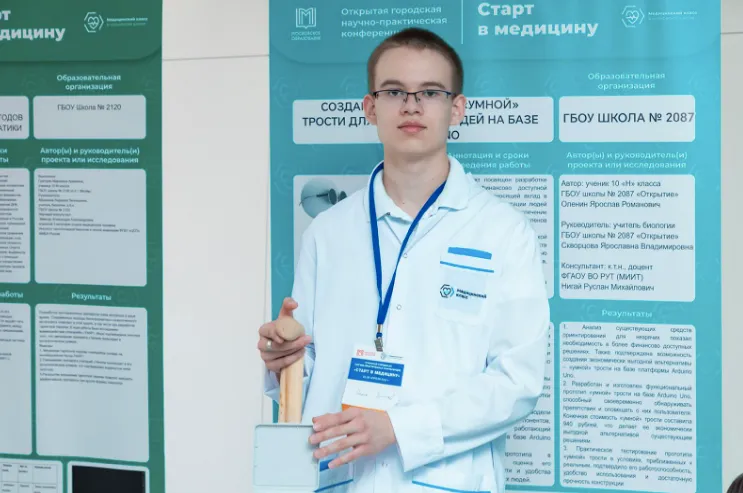
A graduating student at School No. 2087, Yaroslav Olenin, designed a smart cane aimed at blind users. Similar devices already exist, but Olenin focused on making his version more affordable.
At School No. 2065, Anna Dudkina developed a different kind of assistive device—and won the Start in Medicine conference with it. Her project monitors load on joints and was inspired by personal experience.
Her prototype takes the form of sensor-equipped footwear. Embedded sensors measure movement speed, load, and leg rotation angles, then compare the data in real time with personalized benchmarks based on age, weight, and height. If the readings exceed safe limits, the system emits an audio warning.
The device can operate for about seven hours on a single charge. Dudkina says her next step is to turn the prototype into a finished product.
Together, the projects illustrate how Moscow’s pre-professional education model is pushing students beyond theory. Instead of classroom-only exercises, teenagers are building assistive technologies shaped by cost constraints, usability, and real user needs—bringing school engineering projects closer to early-stage product development than traditional homework.