Russian Scientists Improve AI Tool for Modeling Chemical Reactions and Predicting Molecular Properties
Unlike fully neural-network-based approaches, the new algorithm preserves the fundamental laws of physics while reducing errors in chemical reaction energy calculations by nearly 26%. That enables more accurate simulations of electron behavior in complex chemical systems, improving predictions of molecular properties for applications such as drug discovery, catalyst design, and advanced materials research.
Artificial intelligence can now generate software code and compose symphonies. Yet in the natural sciences, relying blindly on algorithms can be risky. A neural network may produce a mathematically elegant answer that is physically impossible. Researchers from the Zelinsky Institute of Organic Chemistry of the Russian Academy of Sciences (IOC RAS), Skoltech, Lomonosov Moscow State University (MSU), and HSE University have proposed a solution. They developed a hybrid quantum chemistry method in which machine learning does not replace classical physics but works alongside it.
Accuracy Without Breaking the Laws of Physics
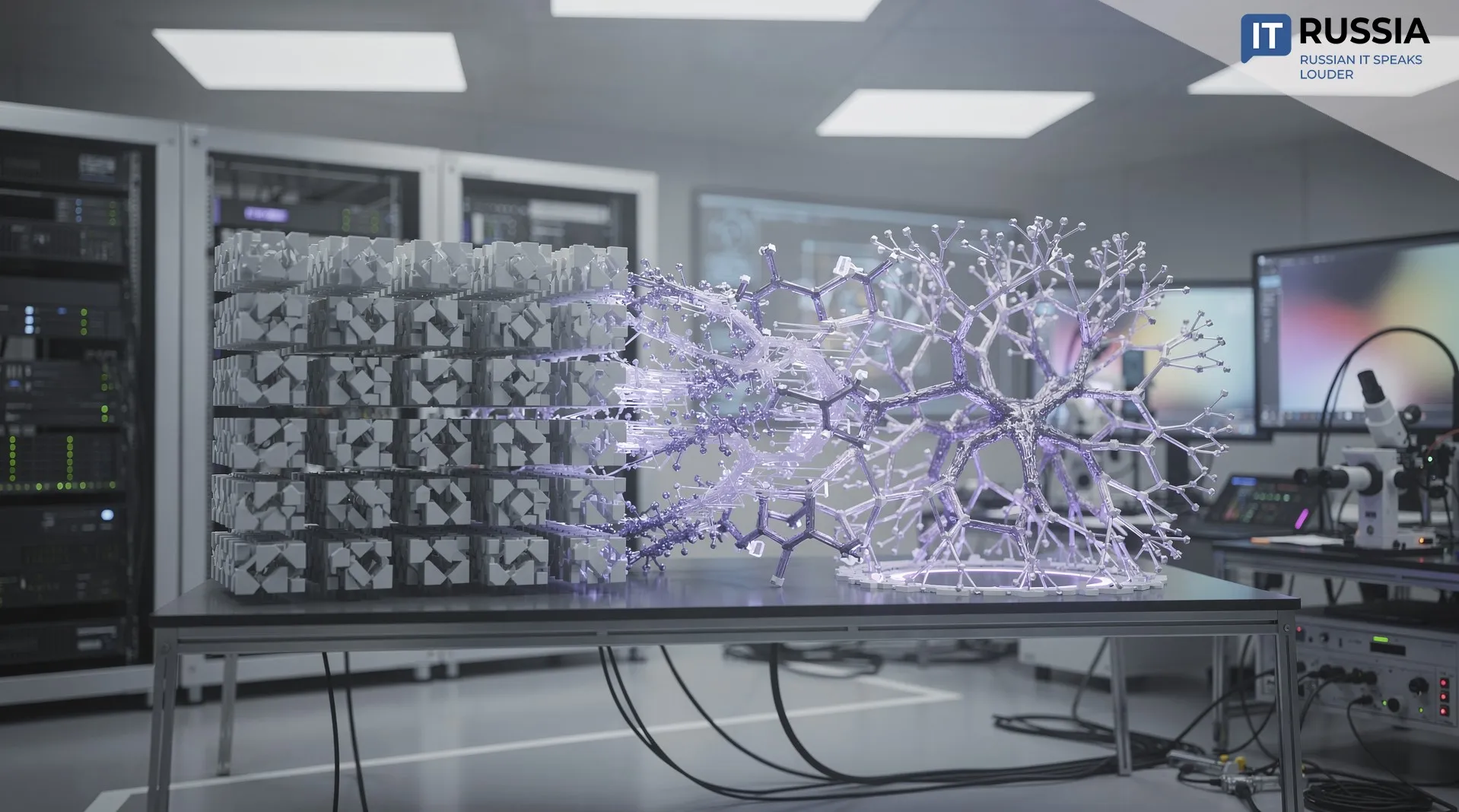
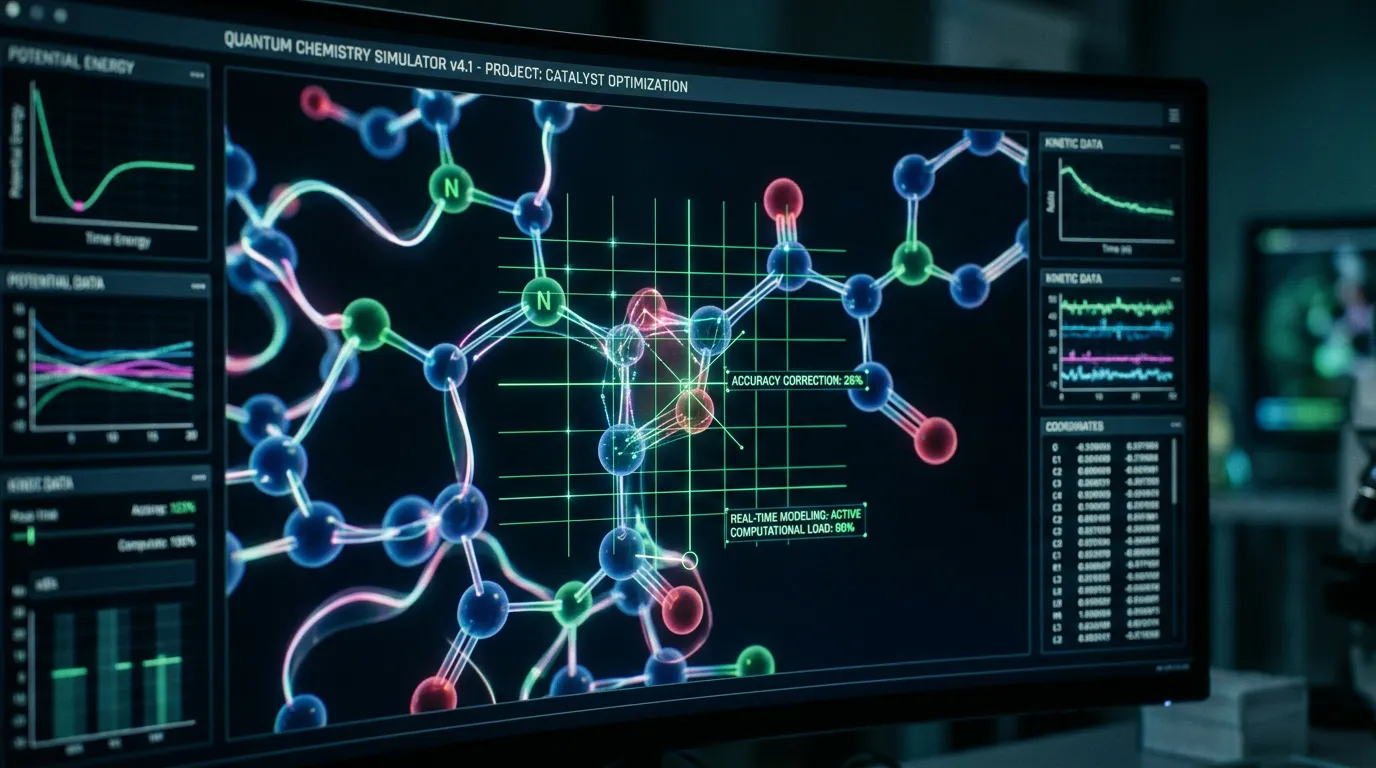
Density functional theory (DFT) lies at the heart of computational chemistry. It is a powerful, though imperfect, framework. The new Russian approach does not attempt to construct molecular models from scratch. Instead, the algorithm starts with a physically grounded density functional and uses a neural network to fine-tune its parameters.
The neural network was trained on molecules whose energies were already known. Tests across 30 classes of chemical reactions showed that the hybrid approach performs calculations nearly 26% more accurately than conventional methods. Its defining achievement is that the algorithm remains strictly constrained by the fundamental laws of nature. It avoids the principal weakness of "black-box" AI systems – producing formally correct answers at the expense of violating the underlying laws of physics.
The Evolution of the "Digital Chemist"
Russia's computational chemistry community has steadily integrated AI into scientific research. In 2023, Russian researchers improved machine learning architectures for predicting material properties. In 2024, neural networks learned to identify highly complex phosphonium salts. By 2025, AI algorithms had acquired what researchers described as a "chemist's intuition," discovering previously unknown molecular and peptide geometries.
In the spring of 2026, the research group led by Mikhail Medvedev identified a "blind spot" in conventional DFT methods – an inability to distinguish between electron systems with different physical behavior. The new hybrid model effectively provides a way to address that limitation. In parallel, in March 2026, researchers at AIRI applied three-dimensional graph neural networks to calculate the optical properties of materials, reducing prediction errors by 30%. Together, these advances are building a powerful scientific foundation. Over time, the new method could enable virtual compound screening, reaction mechanism analysis, and the design of materials with targeted properties.

Strategic Sovereignty in a Test Tube
Developing new medicines, discovering industrial catalysts, and creating advanced materials all require enormous investments in laboratory experimentation. Virtual compound screening powered by accurate Russian AI models has the potential to reduce both development time and costs dramatically.
The technology also carries strategic importance. Having domestic computational chemistry tools reduces research institutions' dependence on foreign software. The method is expected to be integrated into the open-source PySCF platform, creating a pathway toward practical adoption. As Russian Academy of Sciences academician Valentin Ananikov has noted, neural-network-based tools are becoming universal instruments for solving applied scientific problems, with chemistry at the forefront of that transformation.

The Global Shift Toward "Physics-Informed" AI
Scientific research worldwide is moving toward the concept of physics-informed artificial intelligence. Researchers are increasingly looking beyond fully autonomous neural networks that can hallucinate in domains requiring strict scientific accuracy. The Russian study suggests that the future belongs to hybrid systems in which AI serves as an assistant that strengthens established mathematical theories rather than replacing them. The technology also has considerable export potential: Russia could eventually offer not only raw materials but also algorithms, software modules, and molecular modeling services.
For now, however, this remains a fundamental research project rather than a commercial product. The main hurdle to practical deployment is validating the model on chemical reactions that were absent from its training data. Even so, preserving physical constraints substantially improves the likelihood that the method will generalize successfully to entirely new compounds. By teaching a neural network not to violate the laws of physics, the Russian researchers have established a robust foundation for the next generation of digital chemistry.