Siberian State Medical University Registers Ophthalmic+ Medical Device
An AI-powered screening system analyzes retinal images to detect disease at an early stage
Siberian State Medical University has registered its own development as a medical device with Russia’s healthcare regulator for the first time. The certification covers the telemedicine clinical decision support system Oftalmik+ (Ophthalmic+), designed to diagnose diabetic retinopathy. Registration allows the university, acting as a manufacturer, to bring the software to market. During a pilot project in the Tomsk region, the technology helped preserve vision in more than 700 patients, the university’s press service told IT Russia.
New Approach
According to the university, Oftalmik+ is not a standalone product but a new model for organizing diabetic retinopathy screening that can be deployed across any region of Russia.
The project originated at the university’s ophthalmology clinic under the leadership of department head Yana Martusevich, where clinicians regularly encountered cases of late-stage diabetic retinopathy diagnosis. The Scientific and Technological Center Tsifrovaya meditsina i kiberfizika (Digital Medicine and Cyber-Physical Systems), led by Ivan Tolmachev, handled the technical implementation and software development.
The Oftalmik+ digital screening model combines specialized software with a digital portal that uses artificial intelligence to analyze retinal images and detect pathology at an early stage. Final clinical decisions remain with physicians. The system enables initial patient screening outside ophthalmology offices, including preventive care units and primary care settings. Doctors receive a probability assessment for diabetic retinopathy along with a segmentation map highlighting pathological areas.
Eyes as a Diagnostic Window
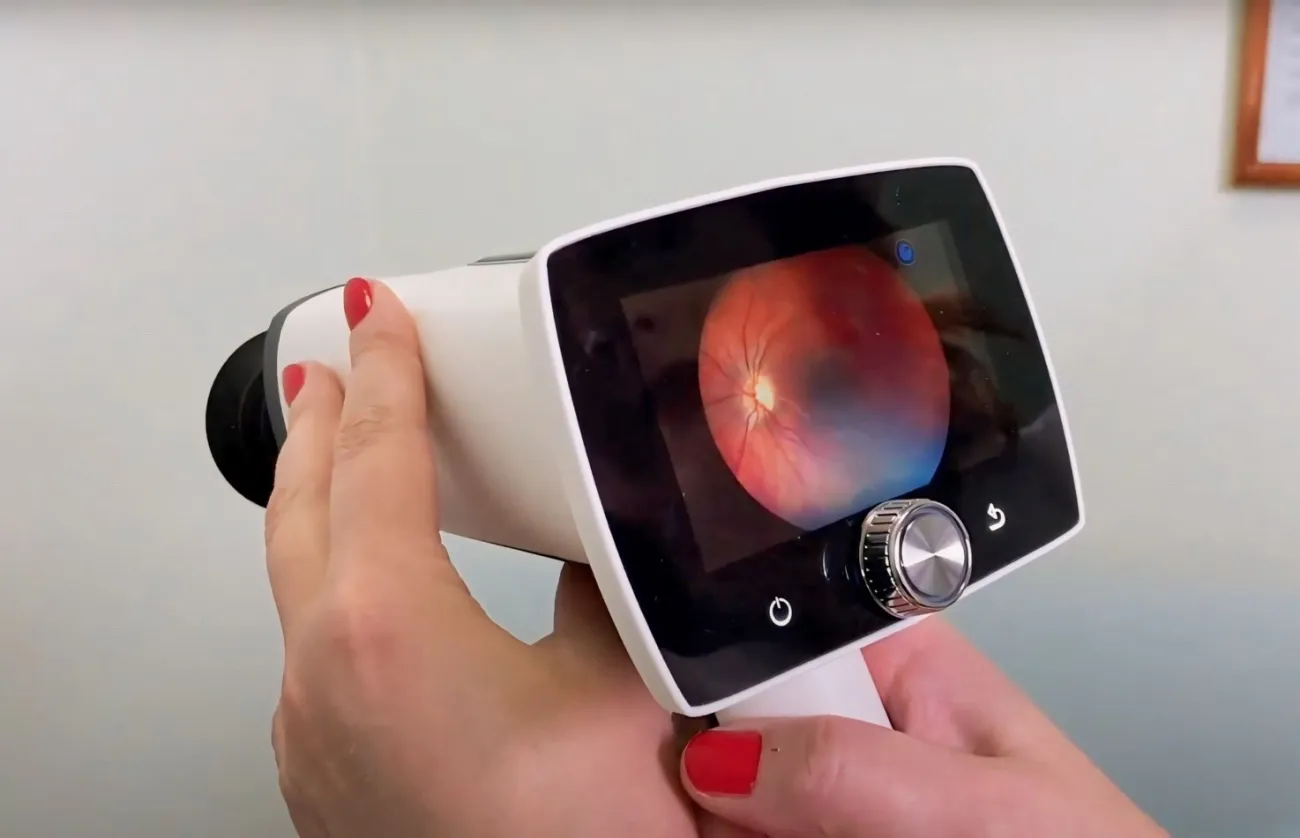
University engineers are now developing a prototype of a portable fundus camera. Because retinal imaging is often performed by mid-level medical staff, the design prioritizes ease of use. The system architecture supports the DICOM standard, allowing the software to work both with its own camera and with devices already used in healthcare facilities.
The team also plans to expand the algorithms to detect additional conditions. Since retinal blood vessels reflect the state of the entire vascular system, image analysis could be used to assess risks of cardiovascular complications, including heart attacks and strokes.
The system is already being tested in several regions, including the Tomsk, Kostroma, and Sakhalin regions, as well as the Kamchatka Territory.
Earlier, we reported that Russian researchers had trained AI to model brain activity based on eye movement.