Technologies That Bring Light: How Russian Scientists Are Restoring Vision
Russian researchers have developed neural implants designed to restore functional vision to people who are completely blind.
A Door to Another Reality
On the eve of the New Year, as millions of people decorate trees and walk along streets lit by bright garlands, hundreds of thousands of people who are completely blind still live in total darkness. In 2025, however, something happened that can reasonably be described as one of the most significant scientific and technological breakthroughs of the decade – blind patients gained a real chance to see.
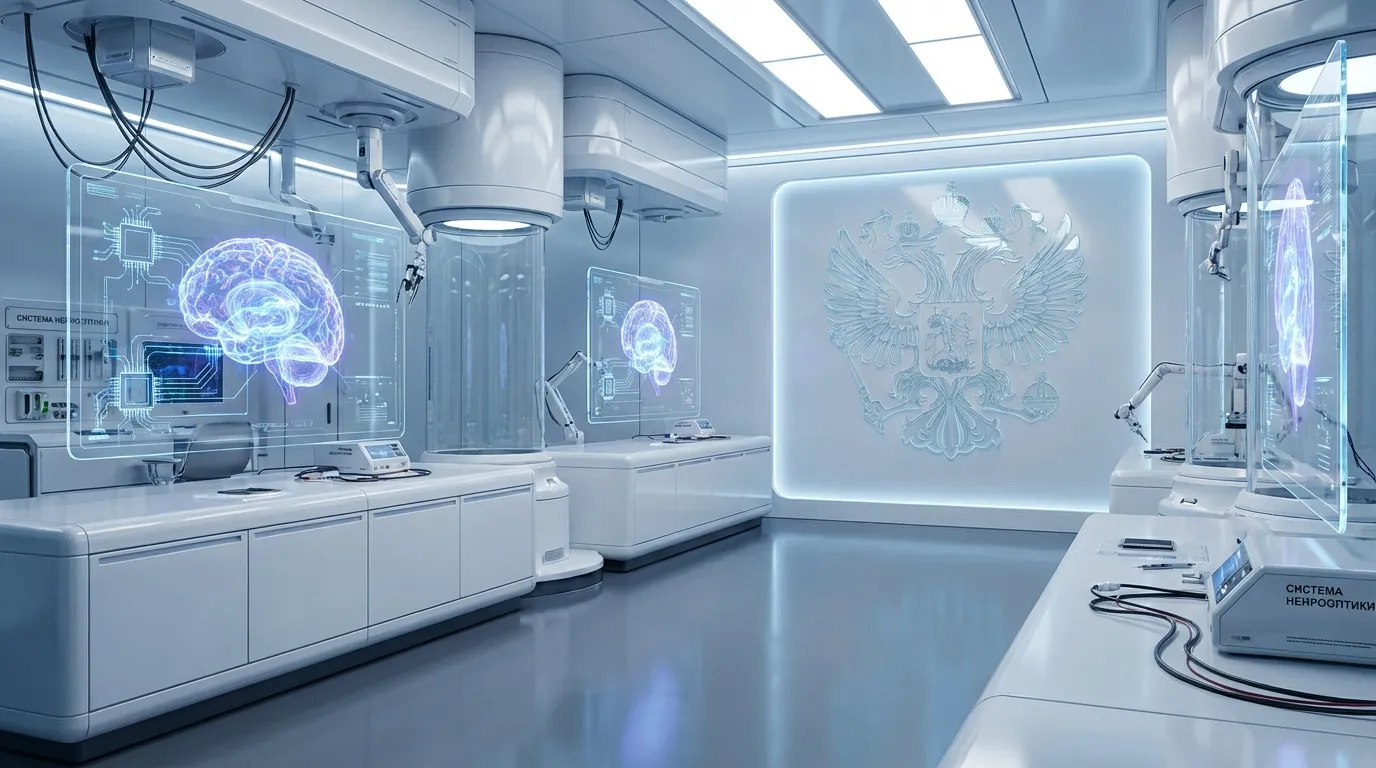
At Russia’s Sensor-Tekh Laboratory, with support from the So-Edinenie (To-Gathered) Foundation, researchers created ELVIS – the first neural implant developed in Russia that bypasses the eyes entirely and “draws” images directly in the brain. This is not a bionic eye in the conventional sense. It is not a camera-equipped headset like the now-defunct Argus II, which was abandoned in the United States, leaving implanted patients without long-term support. Instead, ELVIS represents a shift to a different paradigm, where vision is generated not in the retina but in the brain itself.
From Failure to Hope
Just a few years ago, the world celebrated what seemed like a triumph: bionic eyes promised to restore sight. In practice, those systems proved fragile, expensive and temporary. The American developer ultimately shut the project down, leaving patients with implanted devices quite literally “in the dark.” Today, science is moving beyond the eye and directly into the brain, where all sensory perception, including vision, is formed.


The ELVIS V system, developed entirely in Russia, consists of an external headband with cameras – resembling futuristic eyewear – and a tiny chip implanted in the visual cortex. The cameras capture images, while the implant converts them into neural signals that the brain interprets as outlines, light and motion. Users will not see color or fine detail, but they can distinguish a door from a wall, a person from a tree, a cup from a spoon. Most importantly, they can move confidently through space.
Built Entirely in Russia
“It was essential for us to develop everything in Russia,” says Denis Kuleshov, the project’s lead. This is not a matter of symbolism but of long-term accessibility and independence. All components, including microelectronics and software, are created with the participation of leading institutions such as MIREA University, Sechenov University, the Russian Academy of Sciences and other major research centers. That means the technology cannot simply disappear due to sanctions or commercial decisions made by foreign corporations.
By 2027, implantation surgery could become available across Russia for all patients who need it. The team is also working toward enabling a single person to receive both “vision” and “hearing” through neural implants. For people who are both blind and deaf, this represents a path out of complete sensory isolation and toward a more independent life.
Imagine a person who has never seen light recognizing the outline of a New Year’s tree for the first time, learning what a mother’s smile looks like, or walking down a street without assistance. This is no longer science fiction – it is approaching reality. And it is being built in Russia by scientists who believe technology should serve people, especially the most vulnerable.
As we look at holiday lights this year, it is worth remembering that for some, those lights may soon become visible for the very first time. That light is not the result of magic, but of sustained research, conviction and science.