Employment Bot “Vika” Brings Job Search Support to Russia’s Omsk Region
The virtual assistant provides essential information about job openings and employment procedures. Full job placement through the bot is expected to become possible after it is integrated with the Rabota Rossii (Work in Russia) portal and other digital services.

Government services have become more accessible for residents of Russia’s Omsk Region, this time in the area of employment. The regional branch of the Rabota Rossii (Work in Russia) Employment Center has launched a virtual assistant called Vika in the MAX messenger platform. The chatbot provides round-the-clock guidance on registering with the employment service, required documents, available vacancies, and self-employment registration. Employers, meanwhile, can receive instructions on registering with the Rabota Rossii portal, posting vacancies, and using government hiring incentives available for certain categories of workers. When necessary, the bot transfers users to a hotline operator.
At present, the service functions primarily as an information and navigation tool. Applications for assistance in finding a job must still be submitted through Gosuslugi (State Services portal) or the Rabota Rossii portal.

What Can the Chatbot Do?
Similar employment chatbots are already widely used in many countries. Human employment advisers continue to handle the core services, while virtual assistants have proven quite effective at providing routine guidance. For residents of the Omsk Region, the service can significantly reduce the time required to find information and decrease the need for in-person visits to the employment center. At the same time, it reduces the routine workload for advisers, allowing them to focus on more complex cases and deliver faster, higher-quality assistance.
This digital solution is likely to be replicated in other Russian regions. That would create a unified network of employment-center chatbots on the MAX platform. The next stage could transform the current reference bot into a full-featured digital employment assistant. Future capabilities may include recommending vacancies based on a user's experience, scheduling consultations, sending updates on application status, notifying users about interview invitations, and providing information on available support measures. Such integration would naturally complement the Rabota Rossii portal, which already supports online applications, vacancy matching, resume preparation, and assistance with employer communications.
Without integration with vacancy databases and users' personal accounts, however, the service will remain primarily an information channel. Its practical effectiveness should ultimately be measured by the number of users, the share of requests resolved without operator involvement, referrals to the Rabota Rossii portal, and actual job placements.

The Chatbot Moves to Its Native Platform
The expansion of government chatbots has become one of the defining trends in the digital transformation of public administration in recent years. St. Petersburg offers a notable example: by the end of 2023, its school meal support chatbot was processing more than 900,000 inquiries each month, while the city's "122" public service chatbot was capable of handling over 90 requests per minute. That experience demonstrated that automating routine consultations can substantially reduce the workload on government service operators.
In February 2025, the Vladimir Region Rabota Rossii Employment Center launched its own chatbot. Its functions were largely identical to those of the Omsk project, but it operated through Telegram, whose services are now restricted in Russia. Later that summer, the national MAX digital platform was introduced, and legislation established a legal framework allowing government and commercial services, electronic documents, and citizen interaction tools to be hosted on the platform.
Employment Services Could Be the Next Step for MAX
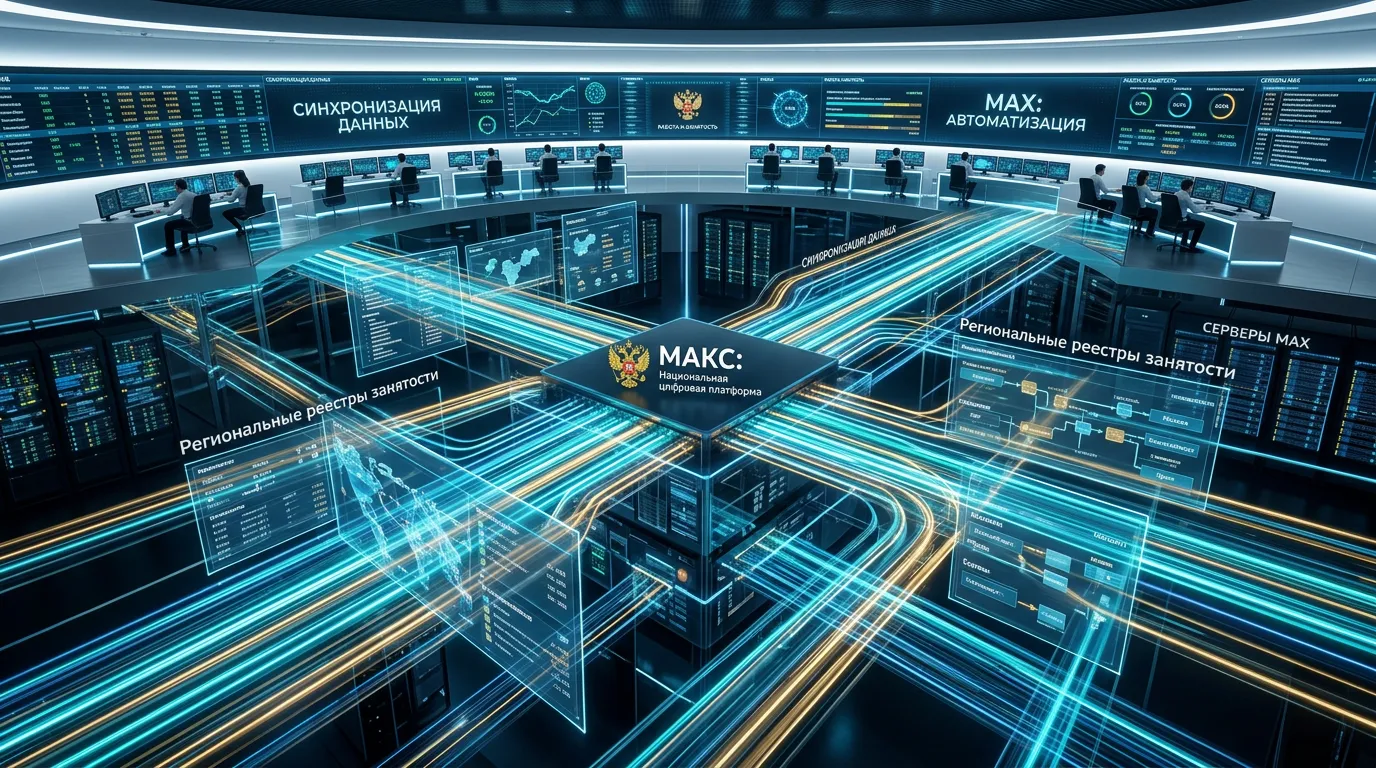
In practice, the Omsk chatbot represents the migration of an already tested model to a domestic digital platform. Its main advantage is round-the-clock access to standard employment information through a familiar messenger interface. Similar virtual assistants are already operating across multiple sectors and regions, helping residents save time and effort when searching for information.
Over the next few years, comparable assistants are likely to appear in most regional employment centers. Their value is expected to grow as they are integrated with the Rabota Rossii portal, regional vacancy databases, and appointment scheduling systems. As those integrations expand, the bots will gradually evolve from providing information to connecting job seekers directly with the right employment specialists. At that point, full job placement through the MAX messenger platform could become a practical reality.