Yamal-501 Satellite Secures Required Spectrum Allocation
The new satellite will replace a spacecraft that has been operating in geostationary orbit since 2012.

Russia's geostationary satellites have long demonstrated their reliability, providing stable communications and other digital services to many of the country's remote regions. Like all spacecraft, however, they have a finite operational lifespan. Timely replacement is therefore essential to ensure uninterrupted operation of the nation's telecommunications infrastructure.
A Key Regulatory Milestone
Russia's State Commission for Radio Frequencies, GKRCh (State Commission for Radio Frequencies), has approved the allocation of the radio spectrum required by Gazprom Space Systems. The frequencies will support the Kupon-1M satellite network, which will operate using the new Yamal-501 communications satellite.
The allocation covers Ku-band frequencies of 13.75-14.5 GHz for Earth-to-space links and 10.95-11.2 GHz, 11.45-11.7 GHz, and 12.5-12.75 GHz for space-to-Earth links. These frequency assignments are intended for operation of the Yamal-class spacecraft as well as standard ground stations and associated test facilities.

Domestic Technology Takes Priority
The commission's decision specifically requires that radio-electronic equipment operating on the allocated frequencies be Russian-made and included in the Unified Register of Russian Industrial Products. Additional requirements include compliance with the Radio Regulations, prevention of harmful interference with the radio astronomy service in the 14.47-14.5 GHz band, international coordination and legal protection of the assigned frequencies, and registration of ground stations. The company must also submit the required filing documentation to the International Telecommunication Union within three years.
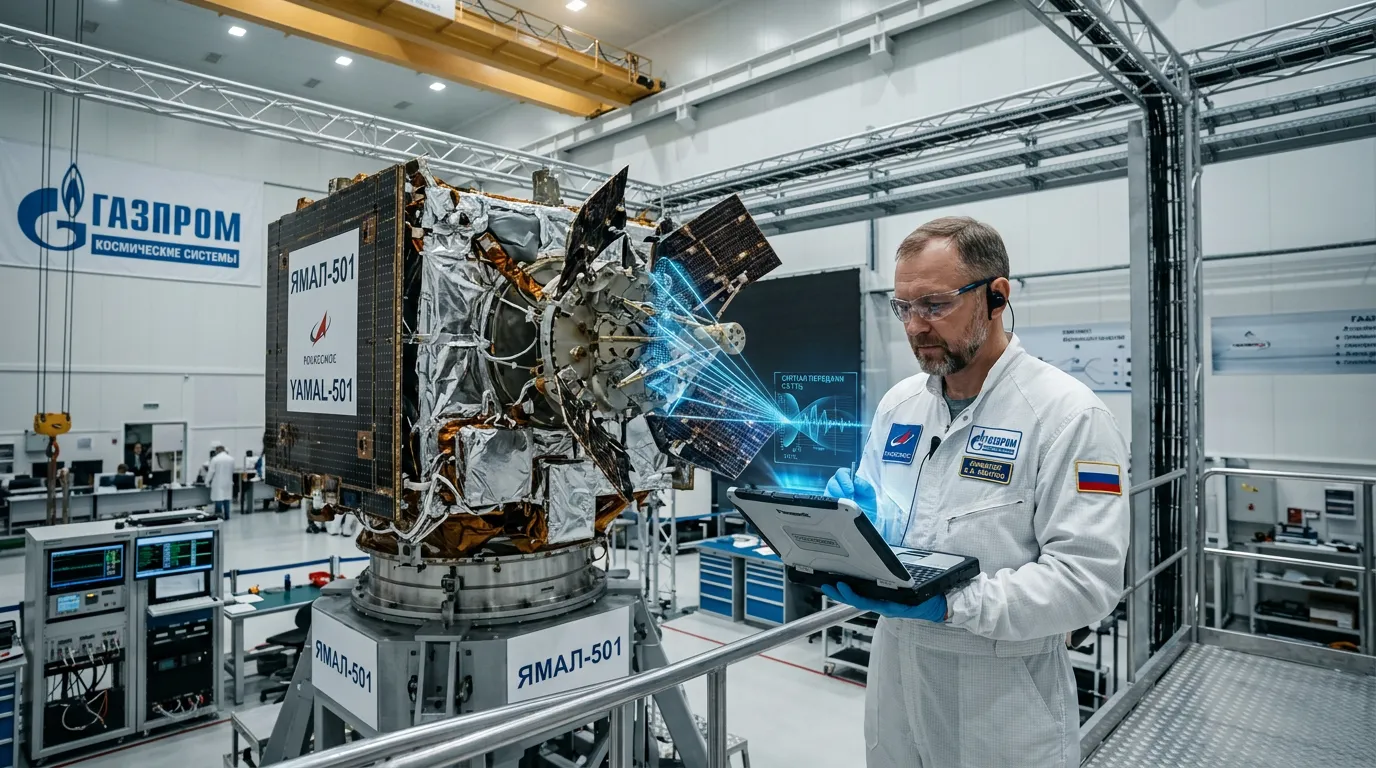
Yamal-501 is intended to replace Yamal-402, which entered service in 2012 and has reached the end of its operational life. The new satellite is being developed by Reshetnev on the Express-1000 platform. The manufacturing contract was signed in 2023, while the spacecraft's final configuration was approved and the preliminary design phase completed in 2025. The satellite is designed for an operational life of approximately 15 years and is scheduled for launch in 2027. It will be positioned at 55 degrees east longitude.
Service Continuity Will Be Maintained
“The coverage area of Yamal-501 mirrors that of Yamal-402. As a result, customers currently using the existing satellite will become potential users of the new spacecraft's capacity. Those customers include government agencies, enterprise clients, mobile network operators, and television broadcasters,” Gazprom Space Systems said.
It is worth noting that Russia completed a major upgrade of its geostationary satellite constellation in 2022, when the Express-AMU3 and Express-AMU7 telecommunications satellites entered commercial service. The spacecraft were deployed at orbital positions of 103 degrees and 145 degrees east longitude to serve Russian Satellite Communications Company. Following their deployment, the operator ranked fourth globally by the number of geostationary satellites in service and by C-band and Ku-band capacity.

A Parallel Development Program
At the same time, development continues on the Express-AMU4 satellite. It is expected to become one of Russia's first modern geostationary communications satellites built with a predominantly domestically produced payload. Industry experts acknowledge that the program has experienced delays following sanctions and the withdrawal of foreign partners. Even so, completion remains targeted for 2028.
“Express-AMU4 became the first project included in the Industrial Competence Center program. Its primary objective is to demonstrate that Russia is capable of independently manufacturing communications and television broadcasting satellites,” said Aleksey Volin, Director General of Russian Satellite Communications Company.
Meeting the deployment schedule for Yamal-501 is now a key priority. The satellite is expected to become an important element of Russia's telecommunications import substitution strategy. The most realistic scenario is maintaining the existing customer base while gradually expanding satellite services across Russia, Africa, and the Middle East.