RESHETNEV Tests Express-RV Satellite Orbit-Correction Systems
The satellites are expected to provide reliable connectivity across Russia’s northern regions.

Russia has made Arctic development one of its current priorities. In particular, substantial efforts are going into providing reliable communications across the country’s northern regions. Connectivity is essential for safe navigation, weather services, environmental monitoring and other activities. Satellite technology is especially important here because laying terrestrial lines across permafrost is either prohibitively expensive or simply impossible.
A Key Milestone Completed
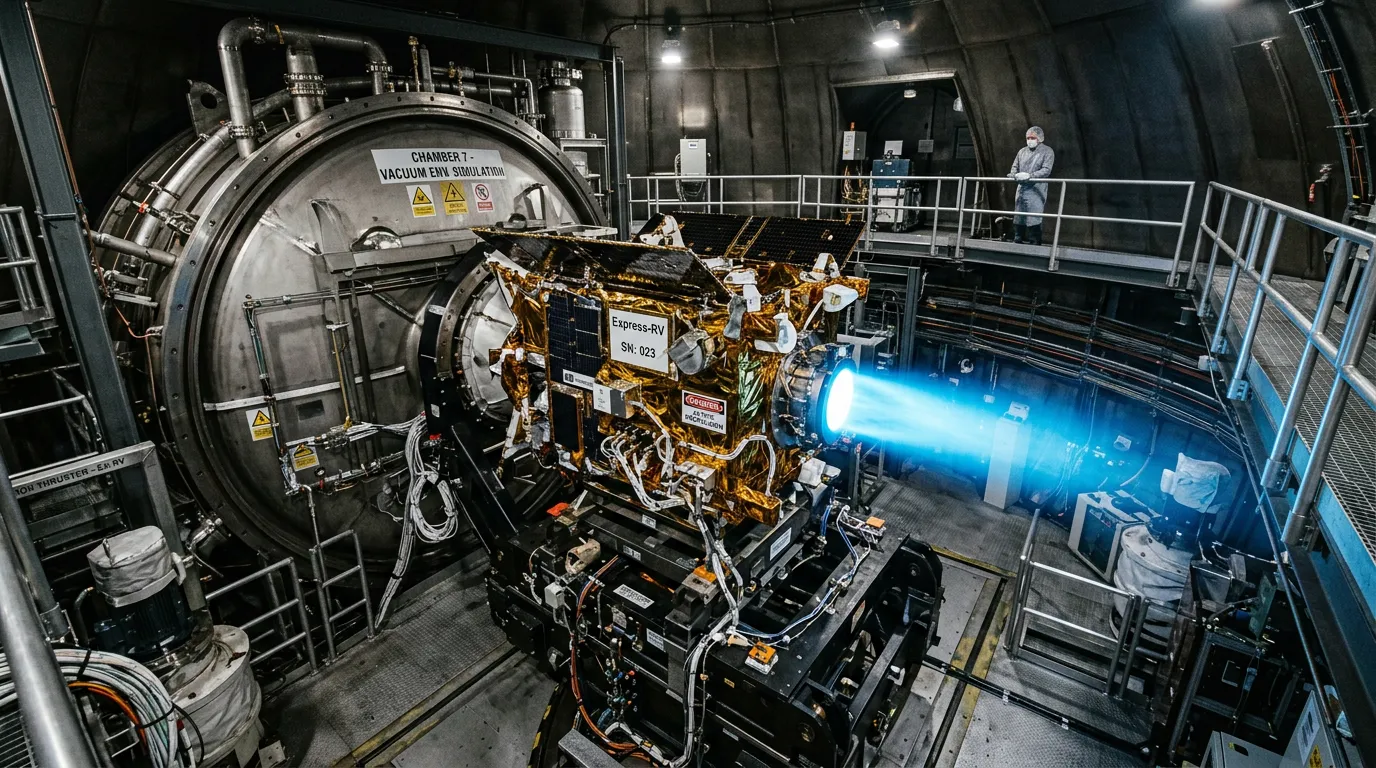
The Express-RV constellation, being built by RESHETNEV, is designed to give the Arctic reliable access to communications and other digital services. The spacecraft program recently cleared another important technological milestone: the company’s engineers conducted hot-fire integration tests of the orbit-correction system for the new communications satellites.
“Hot-fire testing is a series of checks that simulate the operation of orbit-correction thrusters under conditions as close as possible to those in space. The goal is to confirm that all components of the orbit-correction system – the thrusters, power supply and control system, propellant feed units and so on – interact correctly and meet the specified requirements,” Roscosmos, the state space corporation that includes RESHETNEV, said in a statement.
Flight Hardware Can Now Be Built
The tests were conducted in a horizontal vacuum chamber that simulates conditions in near-Earth orbit. Engineering prototypes of equipment that will later be used in operational hardware were tested there. The trials confirmed that all major components of the satellite orbit-correction system were fully operational and that their characteristics fully met the technical specifications.
The engineering teams are now moving to the next step. They will manufacture the flight version of the satellites’ orbit-correction system and conduct the required acceptance testing.
“Ground testing is a critically important stage. It allows us to make sure the satellite is fully operational while it is still on Earth, before it is launched into orbit. This significantly increases the spacecraft’s reliability in space,” Roscosmos said.

Orbits Tailored to the Far North
The Express-RV constellation will comprise four satellites operating in highly elliptical orbits, which are particularly well suited to communications at polar latitudes. Their advantage comes from the trajectory: each satellite spends an extended period near apogee over the Northern Hemisphere. This is the key difference from geostationary satellites, which remain fixed relative to Earth and cannot deliver the required quality of network coverage to far northern regions.

Closing the Digital Divide
Construction of the Express-RV satellites is part of Sfera (Sphere), a federal project aimed at advancing Russian space technologies and closing the country’s “digital divide.” Work on the spacecraft themselves began in 2022. They will carry equipment operating in the C, Ku and L frequency bands and have a guaranteed active service life of 10 years. The Express-RV orbital constellation will deliver communications services, including broadband internet access, across all of Russia and the waters of the Arctic Ocean. The Express-RV satellite communications system will have total throughput of up to 8 Gbit/s, with maximum transmission speeds of 60 Mbit/s for each subscriber terminal.
Comprehensive prelaunch hardware testing is a mandatory part of the work performed by all companies in the space industry, including RESHETNEV. In 2025, the company reported successful hot-fire tests of the orbit-correction system for the Express-AMU4 spacecraft. That system consists of multiple components, including stationary plasma thrusters, a control unit, protection filters, a cable network and other elements.
The successful testing of the Express-RV satellites’ orbit-correction system shows that the spacecraft program has passed an important milestone. Putting the constellation into orbit will give fresh momentum to the development of Russia’s northern regions.