Engineering Intelligence for the Chemical Industry
Russian chemical engineers are building an alternative to global process simulation software leaders. EuroChem, one of the world's largest mineral fertilizer producers, is developing a process simulation platform in partnership with a consortium of four leading industrial companies. The software suite is designed to become a full-fledged alternative to foreign systems such as AspenPlus and HYSYS, which have dominated the Russian market for years. The new platform will enable the country's chemical industry to replace imported software for process simulation and production optimization.
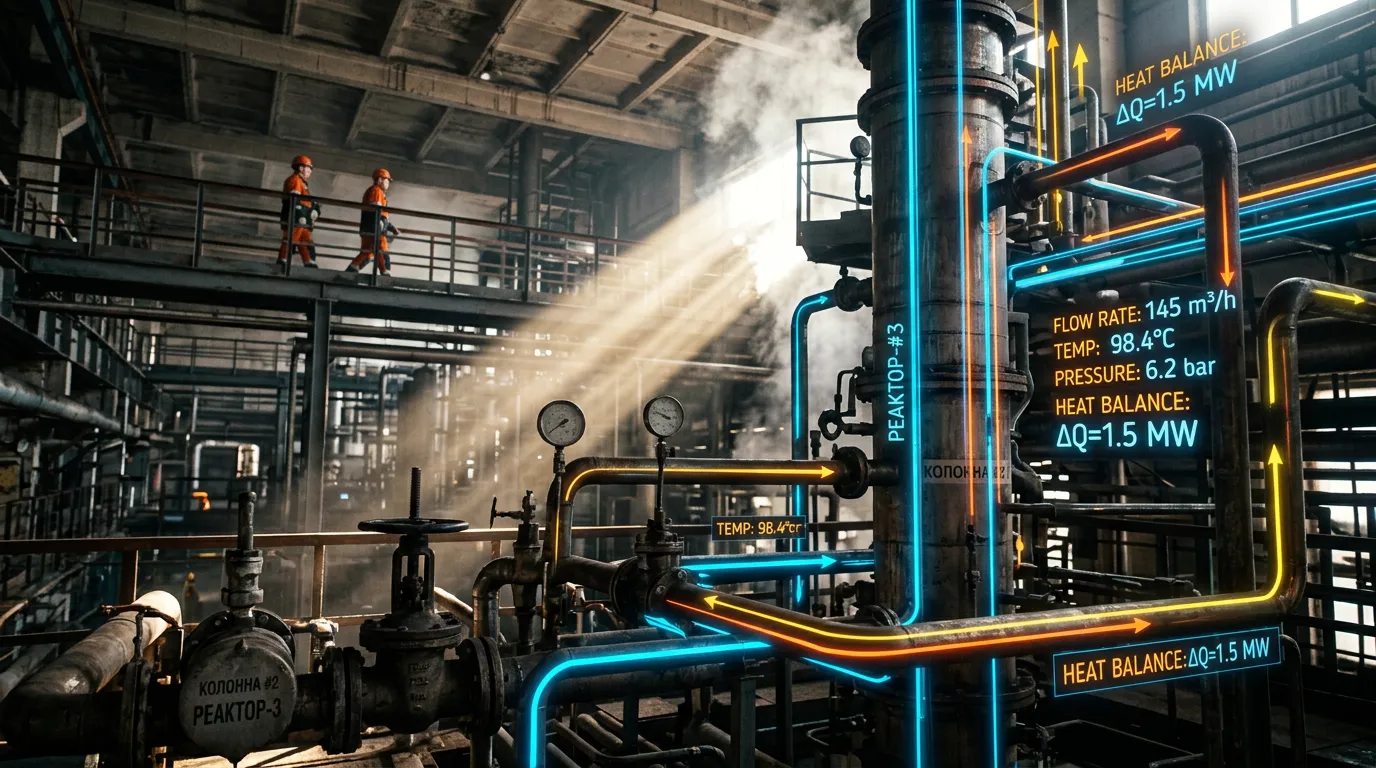
Process simulation belongs to one of the most sophisticated classes of industrial software. Engineers use these systems to create digital twins of production plants, calculate heat and material balances, analyze equipment performance and validate process scenarios before they are implemented. Manufacturing efficiency and operational safety depend directly on these capabilities. The project has been designated a Highly Significant Project by the Ministry of Industry and Trade of the Russian Federation and is being carried out within the Industrial Competence Center (Industrialny Tsentr Kompetentsy; ICC) "Chemicals and Pharmaceuticals," chaired by EuroChem.
Digital Twin for Catalyst Performance
The new platform's first advanced application, created to validate its computational power and reliability, is the Catalyst System Monitoring and Forecasting System (Monitoring Kataliticheskikh Sistem; MKS). The pilot project has been launched at EuroChem-Severo-Zapad in Russia's Leningrad Region. After successful testing on a single production unit, the solution will be scaled across the plant's entire Ammonia workshop during the second half of 2026, covering seven catalysts that play a central role in production. Predictive models will be developed for each catalyst to estimate its remaining service life.
As a result, the facility will be able not only to forecast catalyst replacement schedules more accurately but also to select optimal equipment operating modes based on production plans. In 2027, EuroChem plans to migrate MKS to the new process simulation platform currently under development.

From Thermodynamics to IT Infrastructure
MKS is only one module within the future integrated platform. Over the past nine months, the system's engineering capabilities have expanded significantly, enabling it to simulate a much broader range of chemical process operations. Developers have added four new thermodynamic packages, hydraulic calculations for columns and pipelines, detailed models for heat exchangers, three-phase separators, absorbers, extractors and turboexpanders. Column process simulation has also advanced substantially with the addition of a process flowsheet optimizer, phase equilibrium analysis tools, inverse engineering capabilities, an engineering utilities library and other specialized modules. The platform is steadily evolving into a full-featured solution capable of addressing a wide range of industrial challenges. Particular attention has been paid to cybersecurity and enterprise deployment. The platform now includes the necessary IT infrastructure, including centralized administration, license management, authentication, a report designer and a scripting engine, allowing it to operate within a secure enterprise environment.
The next milestone will be acceptance testing followed by transition to pilot industrial operation. Development plans for 2027 and 2028 include expanding specialized industry modules, extending equipment libraries and thermodynamic packages, and creating application-specific tools that address manufacturers' real production challenges.
The long-term objective is to build a living ecosystem in which the platform evolves alongside industry requirements, enabling developers to deliver a more adaptable and competitive product not only in Russia but also across CIS markets in the near future.
A Digital Assembly Line for Import Substitution
Industrial Competence Centers (Industrialnyye Tsentry Kompetentsy; ICCs) for replacing foreign industry-specific digital products and solutions were established by order of the Russian government in 2022. The ICC "Chemicals and Pharmaceuticals" portfolio includes nine Highly Significant Projects with a combined value of approximately RUB 3.5 billion (about USD 45 million). Its first successful initiative was the deployment of SafePlant, a predictive maintenance and diagnostics platform developed by NPO Diatekh, at the Fosforit production facility. Beginning in 2024, the system was rolled out across additional group assets, and in 2025 SafePlant was recognized as an industry benchmark.
Two additional projects are being implemented by PhosAgro together with Tsifra Group. The partners have developed domestic alternatives to SAP- and Oracle-class MES systems through the projects "Deployment of an Automated Process Control System (Avtomatizirovannaya Sistema Upravleniya Tekhnologicheskimi Protsessami; ASU TP) for a Large Chemical Holding" and "Deployment of the ASUP Manufacturing Execution System for a Large Chemical Holding." AI agents were integrated into ASUP in early 2026.
Uralchem is automating capital investment management using an engineering data management system, creating a unified digital environment covering the entire lifecycle of capital construction projects, from concept to decommissioning. In 2026, the company expanded the project to its subsidiaries.
After its foreign software vendor exited the Russian market in 2022, SIBUR developed its own machine learning model within just three months to replace the imported software. The system works alongside process control systems and Advanced Process Control (APC), analyzing data from hundreds of sensors in real time and selecting optimal operating conditions for pyrolysis, compression and other industrial processes. In 2026, SIBUR plans to launch a process simulation marketplace, making its Real-Time Optimization (RTO) solutions available to other manufacturers across the industry.

Sovereignty at the Molecular Level
Process simulation software and Computer-Aided Engineering (CAE) systems represent one of the most technologically demanding segments of industrial software. The global market was valued at between USD 18 billion and USD 26 billion in 2025. Meanwhile, analysts forecast that Russia's engineering software segment will grow at an average annual rate of 16%, reaching RUB 74 billion (about USD 960 million) by 2030.
Russia is seeking to secure its place in this high-technology market by developing independent solutions. Projects such as the national process simulation platform are strategically important because they address some of the most complex gaps in import substitution. Rather than simply replacing foreign software packages, they provide the chemical industry with its own mathematical foundation for creating digital twins of industrial production.