Numbers, Robots and Precision: Regional Russia Takes Oncology Care to the Next Level
When it comes to high-tech medicine, the image often points to futuristic clinics in major cities. Yet recent trends show that new centers of excellence are increasingly emerging in Russia’s regions, with the Novgorod Region standing out as a clear example.
A visit by a delegation from the N.N. Petrov National Medical Research Center of Oncology to the Novgorod Region has become a strong indicator of how much the system has evolved. Federal-level experts toured key medical facilities, from the regional oncology dispensary to outpatient centers across districts, and delivered a detailed assessment following the visit.
AI “Second Opinion” Supports Physicians
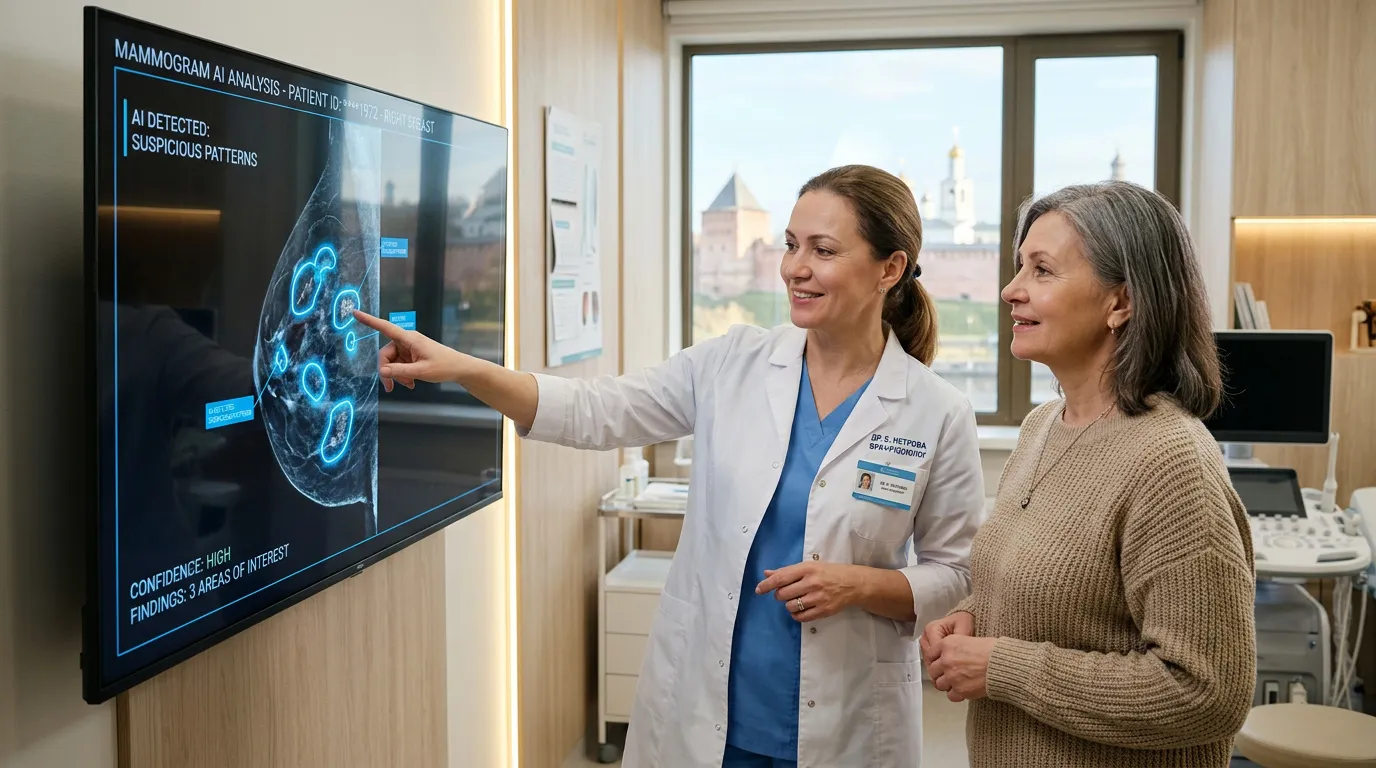
At a meeting with the regional Ministry of Health, the central message was clear: the oncology service has reached a new level. Experts pointed to the introduction of advanced imaging equipment, including CT and MRI scanners, as well as well-organized clinical workflows. In particular, they highlighted the work of a reference center where oncologists perform second readings of mammography scans using AI algorithms. That approach significantly reduces the risk of missing pathology. In practice, a machine-assisted second opinion helps physicians remain confident in their diagnoses.
Experts also noted that the region has established a clear care pathway linking outpatient services, inter-district centers in Borovichi, Staraya Russa and Valdai, and the specialized oncology dispensary. Staffing has also improved, with the introduction of highly specialized roles such as medical physicists.
Precision Within Reach
Today, physicians in the Novgorod Region have access to tools that, just a few years ago, were limited to highly specialized centers. One example is EBUS technology, which combines ultrasound diagnostics with bronchoscopy. Previously, diagnosing lesions in hard-to-reach lymph nodes along the airways required complex and invasive procedures that were difficult for patients. Now, a miniature ultrasound probe enables detailed examination of these areas and allows tissue sampling with minimal risk of vascular damage.
Radiology has also advanced significantly, with a new CT scanner at the oncology dispensary allowing clinicians to detect suspicious tumors in the abdominal and thoracic cavities and the pelvis, while also accurately tracking how patients respond to treatment. That means treatment effectiveness is no longer assessed subjectively, as physicians now rely on precise digital data.
Homegrown Innovation
One of the clearest examples of the convergence between medicine and engineering is the deployment of a robotic system for melanoma diagnostics. The device was developed in Veliky Novgorod through collaboration between medical specialists at Novgorod University and the regional oncology dispensary.
Melanoma remains a growing concern, with incidence in the region nearly doubling in recent years. The new method addresses this challenge by enabling accessible, ultra-early detection. The system operates in a straightforward yet effective way: using a USB microscope, it captures images of pigmented lesions at up to 300x magnification, records physiological parameters and then automatically assesses cancer risk.
The device also builds a database of images, making it possible to track changes in moles over time. The prototype has already been used to screen around 1,300 patients, achieving an accuracy rate of 96–98%.
Surgery and Radiotherapy
Minimally invasive surgical techniques are now standard practice at the oncology dispensary. Video-assisted endoscopic procedures for stenosing cancers of the esophagus, stomach and colon, along with complex combined surgeries on the pancreas and pelvic organs, are performed routinely. For breast cancer patients, treatment options include not only radical surgery but also reconstructive procedures combined with chemotherapy, helping preserve quality of life.
Radiotherapy services have also seen major improvements, with treatment now delivered in a highly targeted way. Conformal radiation therapy allows clinicians to focus on tumors with precision while sparing surrounding healthy tissue.
In April 2025, the dispensary launched a new radiotherapy system, TERAD 200, designed to treat superficial cancers. Advanced control systems ensure accurate dose delivery, minimizing side effects and reducing overall impact on the body.
Export Potential
What is happening in a single region has broader implications for both Russia and global healthcare. It offers a working model of how a modern oncology system can be structured. Expanded diagnostic capabilities, integration of AI into routine workflows and the inclusion of medical physicists all contribute to a unified system that improves early detection and reduces mortality.
The ability to deliver high-quality screening in remote areas is relevant for many countries. Developers are already working to enhance machine intelligence, training systems for deeper automated analysis.
The expertise developed at Novgorod University and the regional oncology dispensary is shaping a new image of Russian healthcare – one that is high-tech, precise and focused on delivering results accessible to patients regardless of where they live.