Uncrewed Surface Vessels Set for Arctic Deployment
In 2026, Arkhangelsk Region plans to launch uncrewed vessels on the Arkhangelsk – Solovetskiye ostrova route, marking a shift from trials to practical deployment of autonomous navigation systems in northern logistics.

The project could improve supply to remote settlements, reduce dependence on seasonal transport, and lower the high costs associated with traditional logistics. For Russia, it also demonstrates an effort to develop a civilian maritime autonomy segment alongside unmanned aviation systems. The initiative spans multiple domains: robotics, navigation software, autonomous control systems, onboard sensors, communications, and digital monitoring. Its development in Arctic conditions is particularly significant, where reliability requirements for digital systems are considerably higher than in standard environments.
From the North to Global Markets
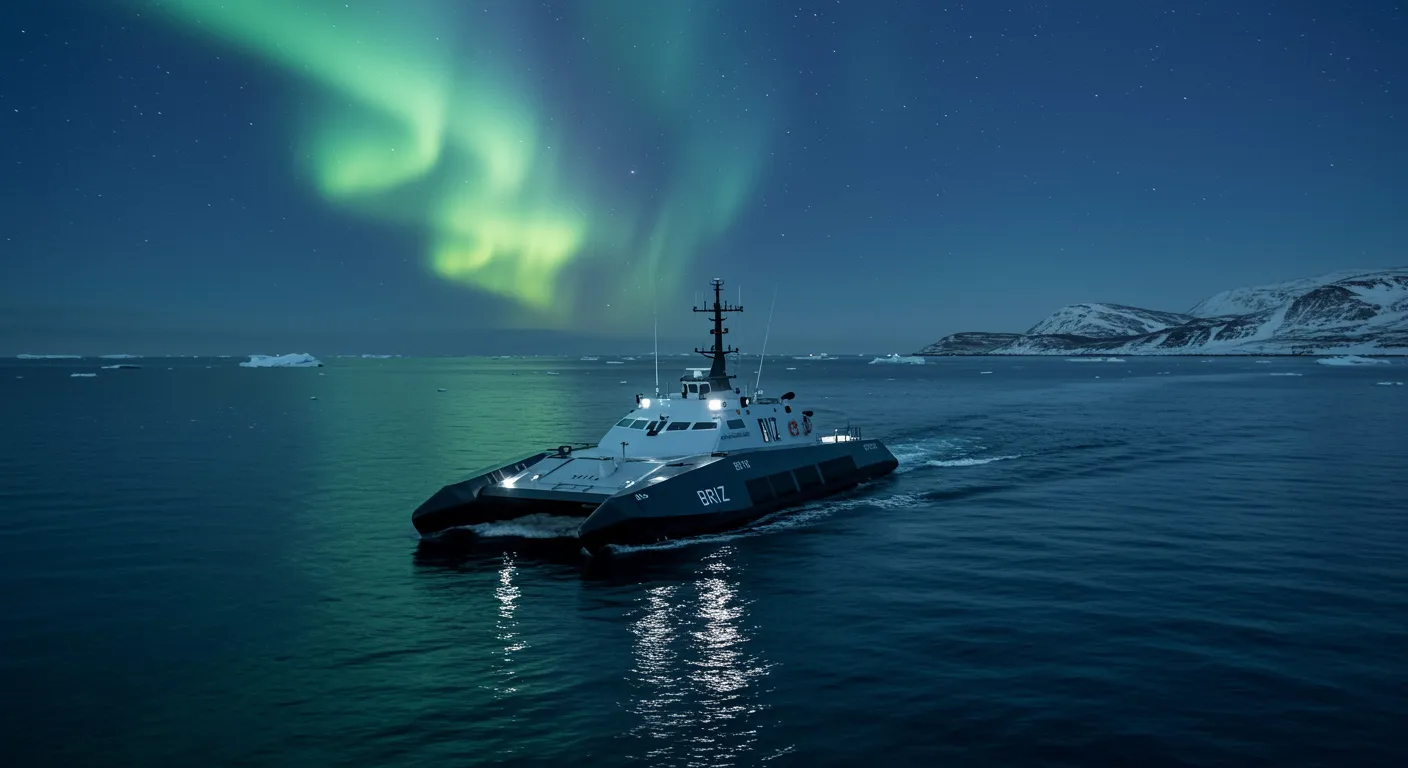
In July 2025, the uncrewed vessel Briz completed an autonomous voyage of about 280 km along the Arkhangelsk – Solovetskiye ostrova route in approximately 21 hours. The region has confirmed plans to deploy two uncrewed vessels in 2026, while Northern Federal University received the vessel Orkan as a platform for research and training.
Within Russia, several development pathways are likely. One is regular local logistics in Arctic and island regions, addressing basic needs for small cargo deliveries. Another is expanding functionality, including ice reconnaissance, hydrographic surveying, and environmental monitoring. The sector also requires workforce development and the creation of a competency center through the training of operators for uncrewed vessels. Replication of this experience across other northern and river regions is also expected if the project demonstrates safety and economic viability.

Export potential lies not in the vessel itself but in the integrated solution set: autonomous navigation systems, dispatching platforms, remote monitoring, machine vision, and operator training. The Russian Maritime Register of Shipping has already introduced new requirements for autonomous vessels, increasing the prospects for wider adoption of such solutions.
Path to Autonomy
The development of autonomous shipping in Russia is progressing in stages. In 2024, the Russian Maritime Register of Shipping introduced mandatory requirements for maritime autonomous and remotely operated surface vessels, which entered into force on 1 July 2024. This established a regulatory framework for the sector.
In July 2025, trials of the uncrewed vessel Briz were conducted, and in November 2025 the Ministry of Transport announced plans to deploy two uncrewed vessels in 2026. At the same time, the industrial base is expanding: reports in 2025 indicated the emergence of domestic production of uncrewed vessels and the development of maritime autonomous platforms.

Globally, similar steps are being taken. The Yara Birkeland project by Kongsberg is positioned as the world’s first fully electric and autonomous container ship. In 2025, the International Maritime Organization continued work on regulatory frameworks for autonomous vessels. The Arkhangelsk project aligns with this global trajectory.
Future of Autonomous Shipping
The Arkhangelsk project moves maritime autonomy in Russia from a demonstration phase to applied logistics. The focus is not only on the vessel itself but on the emergence of a new class of digital infrastructure: autonomous vessels, remote control centers, digital mapping and navigation, safety frameworks, operator training, and integration with port and regional logistics systems.
In 2026, the project will operate in a pilot-regular mode, focusing on reliability, safety, and economic performance along specific routes. The next stage will involve refining regulations, software, and operational procedures. If successful, Arkhangelsk Region could become one of the first Russian testbeds for civilian autonomous shipping in Arctic conditions.
Export potential will depend on the ability to offer not just hulls and propulsion systems but a complete autonomous navigation platform validated through real-world operations and regulatory compatibility. This is a niche but strategically important case for Russia’s IT sector, where digital technologies are entering real-world northern logistics and could evolve into a new area of specialization in transport technology.