Robot for Tight Spaces
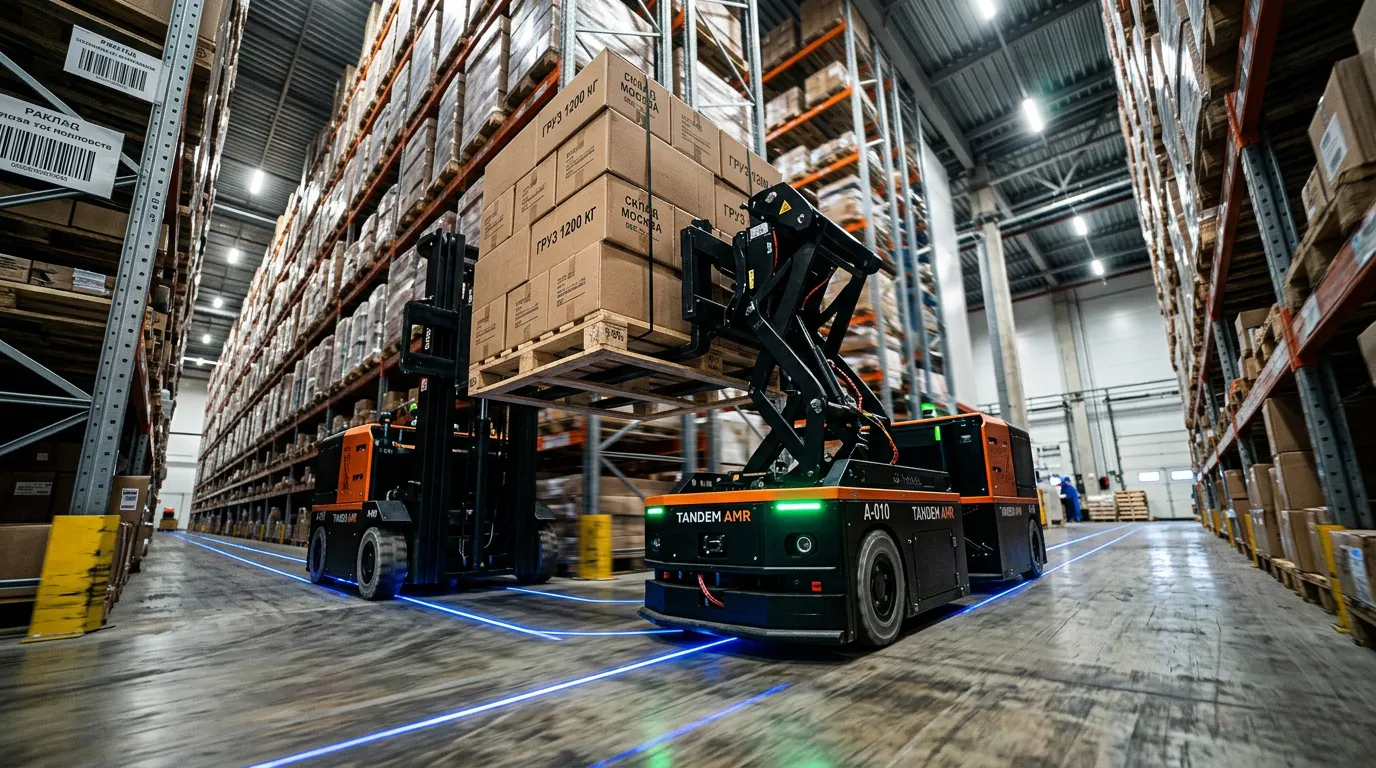
Tandem AMR, a team from Novosibirsk, has created an autonomous mobile robot designed to move pallets through warehouse aisles as narrow as 1.2 meters.
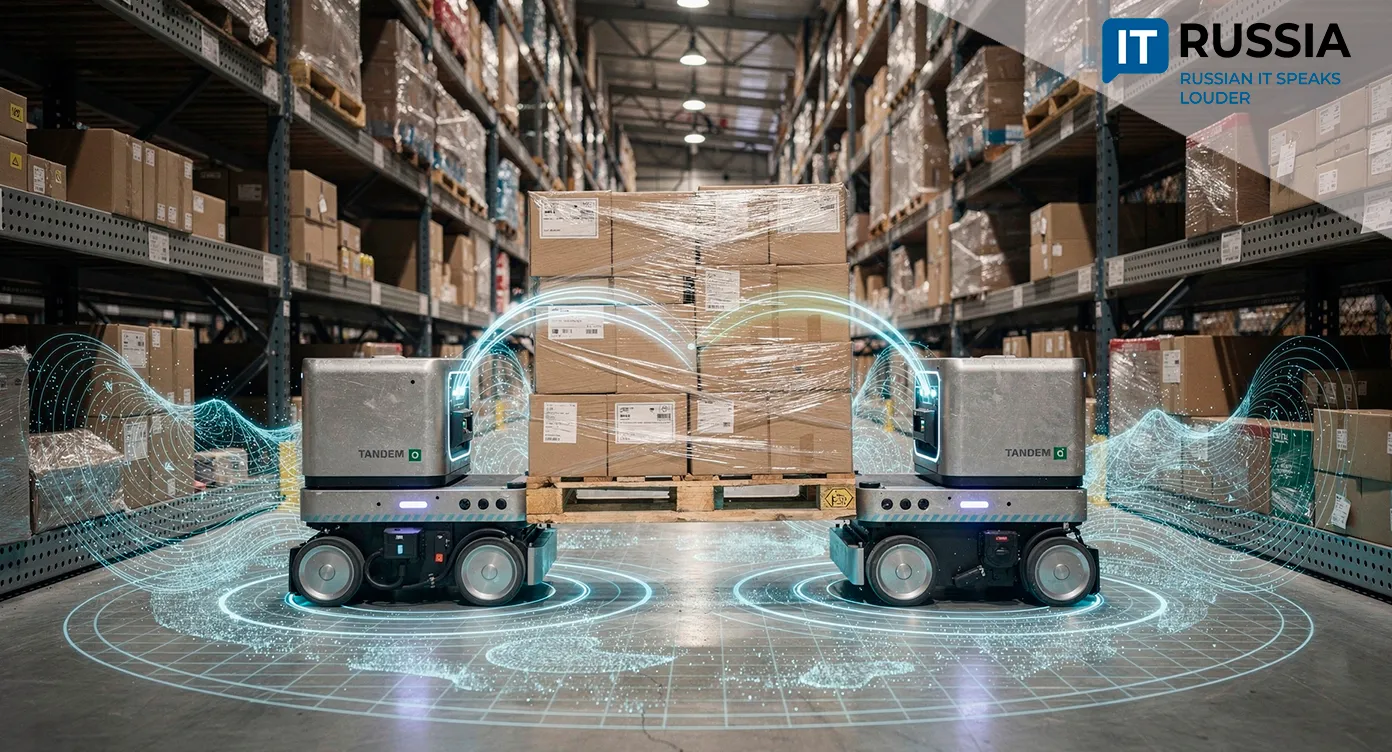
Novosibirsk engineers have developed a modular robot for horizontal pallet transport, including operations in narrow aisles starting at 1.2 meters wide. The system consists of two autonomous modules that independently move underneath a pallet, synchronize with each other, and then operate as a single unit. Combined payload capacity reaches 1.2 tons, while top speed is up to 1.5 meters per second.
For navigation, the robot uses SLAM technology, QR codes and obstacle-avoidance sensors. The project has already completed the proof-of-concept stage, and the team is now working on a production-ready version for testing in real warehouse environments.
The importance of the development lies in its focus on a specific operational bottleneck: automating pallet movement in spaces where conventional forklifts and many warehouse robots simply cannot fit.
For Russia’s IT and industrial automation sector, the project illustrates a broader shift toward specialized engineering solutions built around real warehouse constraints rather than abstract “general-purpose robots.” In the long term, the initiative could help expand the country’s domestic industrial robotics base. Russia currently has just 29 robots per 10,000 workers, while the national target stands at 145 robots.
Future Expansion Paths
In the near term, Tandem AMR is focused on the Russian market. The company is logically targeting facilities with narrow aisles, including warehouses, distribution centers and manufacturing sites.
Demand for this kind of technology is growing. Several major players have already launched robotics initiatives. X5 Group, for example, has begun automating distribution centers, while Yandex Robotics, together with Perekrestok, plans to deploy more than 100 robots for order assembly in fresh-food zones.
Export potential may emerge later, once the team proves the robot’s reliability and operational safety in real-world conditions. Potential markets include EAEU countries, the Middle East, Asia and Latin America – especially regions where rebuilding warehouse infrastructure would be prohibitively expensive. Tandem AMR’s main advantage is its ability to operate in aisles as narrow as 1.2 meters, a critical factor for facilities where floor space is costly and storage density must be increased.
At the same time, the project faces clear risks. The robot is still undergoing testing, competition in the sector is intensifying, and customers increasingly expect not just standalone hardware, but integration with warehouse management systems, planning platforms, service infrastructure, safety frameworks and clear return-on-investment models. The startup will also need to establish manufacturing capacity, secure component suppliers and build a service network.
Russian-Style Warehouse Robotics
The development of Tandem AMR fits into the broader trend of warehouse automation in Russia. In 2024, X5 Group began robotizing distribution centers and launched a testing laboratory for warehouse technologies. That same year, the company deployed mobile robots at one of its warehouses and scheduled a second rollout phase through 2028.
In 2025, Yandex Robotics introduced a picking robot capable of operating at human speed, and later launched a robotized warehouse project involving around 100 robots for Perekrestok. Meanwhile, Ronavi Robotics continues strengthening its position in the market. The company manufactures logistics robots and pallet carriers used in online retail, industrial production and pharmaceuticals.
The Russian government is also backing the trend. MInpromtorg (Ministry of Industry and Trade) has stated that the country’s industrial robot fleet should exceed 100,000 units by 2030.
The Future of Warehouse Robotics
Tandem AMR is still a local startup, but its technology reflects an important market trend: Russia’s robotics sector is advancing not only through massive projects from companies like Yandex and X5, but also through niche engineering solutions built around highly specific operational problems.
Over the next one to two years, the team will need to complete testing at real warehouse sites, prove the economic viability of deployment and demonstrate integration with existing infrastructure. The most likely path forward involves pilot deployments with regional logistics operators or manufacturing companies.
If testing succeeds, Tandem AMR could carve out a niche within three to five years as a supplier of compact autonomous mobile robots for pallet logistics. Scaling the business will require serial production, service infrastructure, a reliable component supply chain and proven economic returns. But if those pieces come together, robots like these could help businesses save warehouse space and accelerate logistics operations without costly large-scale infrastructure redesigns.