Arkanon: A Knowledge Keeper – Tomsk Students Launch an AI Study Platform
The system uses AI algorithms to organize study materials. Within its first month, Arkanon has already attracted around 100 active users.

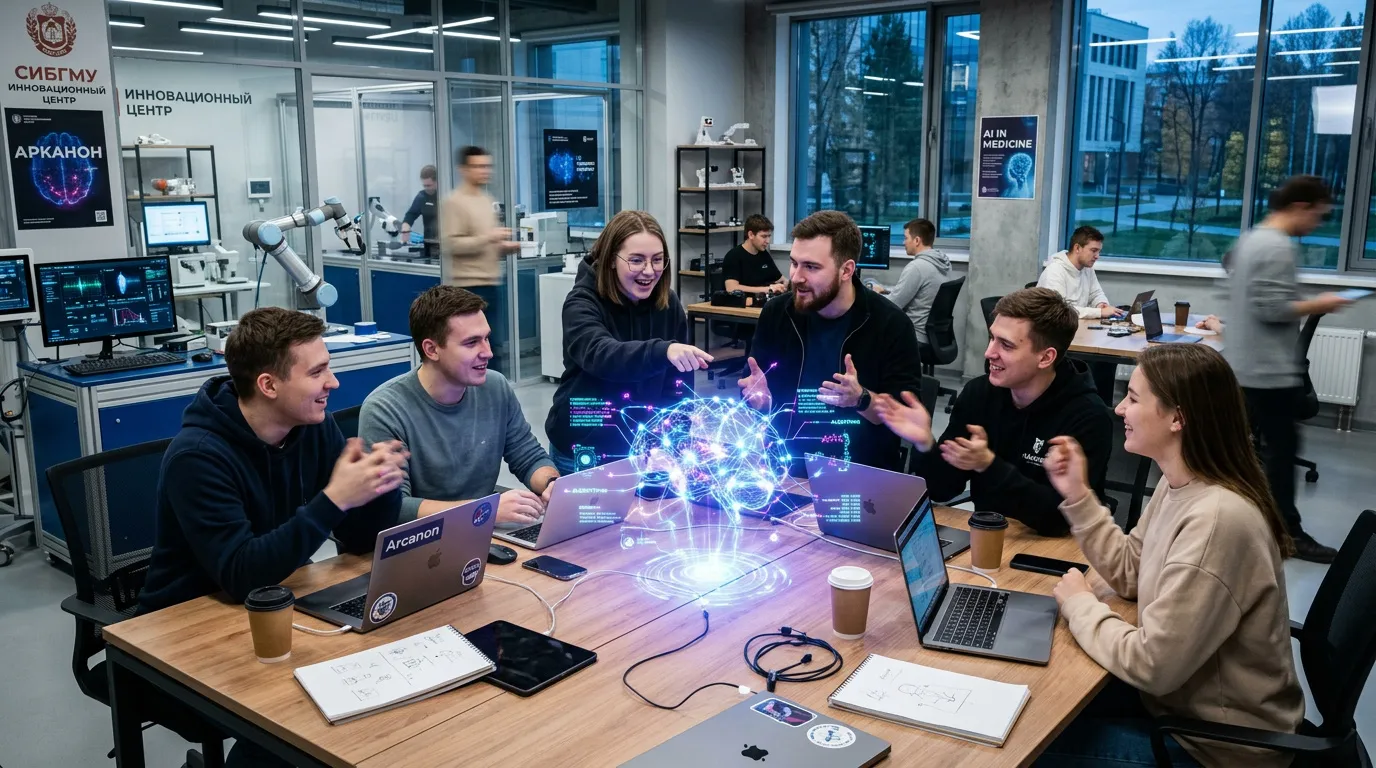
Scattered lecture PDFs, whiteboard screenshots, recorded seminars, and dozens of open browser tabs? A team from Tomsk decided it was time to bring order to academic chaos. Fifth-year students at Sibirskiy gosudarstvennyy meditsinskiy universitet (SibGMU) Alisa Slidnevskaya and Mikhail Voskoboynikov, together with TUSUR postgraduate Dmitry Leonov, launched the Arkanon platform.
Divide and Structure
The service works as an intelligent sorter. Users can simply upload their files, and a neural network transforms them into a structured knowledge base that is easy to navigate. The output includes organized notes with Markdown and LaTeX support, flashcards for memorization, and quizzes for self-testing. If the system makes an error, users can edit the content manually, keeping control in human hands.
The project is only a month old, yet it already has around 100 active users. This is not just a classroom prototype but a functioning tool that helps people study more effectively.
The Power of Spaced Repetition
Arkanon’s core feature lies in its spaced repetition mechanism. The developers built it on the open FSRS (Free Spaced Repetition Scheduler) algorithm, version five, which is already close to the current sixth version.

What makes it different? Traditional apps rely on fixed schedules for review. FSRS, by contrast, evaluates user confidence and tracks forgetting patterns. In practice, the platform learns how each student forgets information. If a concept is easy, the system may schedule a review a week later. If a student struggles, the card may reappear the next day. The system adapts to individual memory patterns, turning study sessions into targeted practice rather than routine repetition. At onboarding, the platform runs a short survey to assess the learner’s level and style, then selects AI models accordingly, ranging from cost-efficient options to more powerful models for complex topics.
A Personal Learning Assistant
Back in February 2025, the Fond sodeystviya innovatsiyam (Innovation Promotion Fund) highlighted winners of the Studencheskiy startap (Student Startup) program, including a 24/7 AI tutor for school students. This confirmed growing demand for personal assistants in education. Meanwhile, major companies have been building infrastructure. Yandex launched pilot projects with Moskovskiy gorodskoy pedagogicheskiy universitet (MGPU) and Natsionalnyy issledovatelskiy universitet Vysshaya shkola ekonomiki (HSE) in 2024 to integrate YandexGPT into the learning process, expanding the initiative to 11 universities by 2025, including SibGMU. In March 2025, Rostelekom and MGPU also announced joint work on personalized learning solutions.
Globally, the trend is moving in the same direction. In 2023, Khan Academy introduced Khanmigo, a tutor designed to guide students rather than simply provide answers. Duolingo added advanced AI features to Duolingo Max, focusing on role-based dialogue. In summer 2025, OpenAI introduced a dedicated “study mode” in ChatGPT. The trajectory is clear: the market is shifting from basic chatbots to intelligent learning companions, and the Tomsk project fits directly into this shift.
Times of Change
The team benefits from the startup studio at SibGMU, an environment designed to turn student ideas into viable products. The founders are already in talks with investors and applying for grants. They are also eligible for support under the Studencheskiy startap program, which offers 1 million rubles (approximately $11,000), and potentially for Start grants, which can reach 5–10 million rubles (about $55,000–$110,000). In the near term, the team plans not only to grow its user base but also to introduce interactive features, including mini-games, to make memorization more engaging.

The broader picture becomes clearer when looking at the numbers. The Studencheskiy startap competition, launched in 2022 by the Innovation Promotion Fund, has received more than 18,000 applications. Of these, 4,500 projects have received grants of 1 million rubles each (around $11,000). Twenty startups have already advanced to the status of small innovative enterprises and moved on to the next stage of the Start program, where funding can reach up to 18 million rubles (approximately $200,000).
Meanwhile, Yandex and HSE have trained 500 students from 11 universities, from ITMO to Tyumenskiy gosudarstvennyy universitet (TyumSU), in working with YandexGPT. Surveys show that 60% of students use AI to structure text, while 51% use it for literature reviews. Notably, 45% rated AI assistance as moderate and 34% as limited. Even at a national level, students see AI not as a magic solution but as a practical tool. Arkanon fits neatly into this context, offering a way to actually learn material rather than simply generate assignments.