Russian AI Brings Stellar Birth to Life
Using neural networks, Russian researchers have animated the process of stellar formation, revealing new details inside the Cygnus Wall — one of the most dynamic star‑forming regions in our galaxy
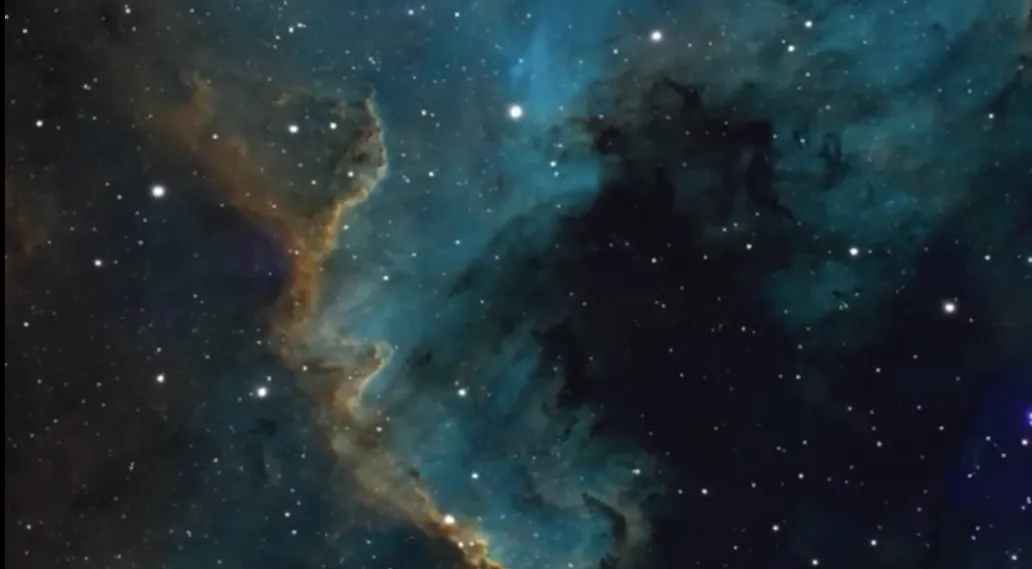
Russian scientists have used the neural network GigaChat to visualize and animate real astronomical data captured in one of the Milky Way’s most active star‑forming zones: the Cygnus Wall. The results, published by the Roscosmos State Corporation, highlight how AI is becoming an essential companion for astrophysics, expanding the scientific value of observational datasets.
To create the visualization, researchers used imagery from the TS‑Optics Photoline 80 mm telescope paired with an ASI533MM Pro camera. More than eight hours of exposure time allowed astronomers to capture faint hydrogen structures that form the backbone of the region. GigaChat processed these raw frames, enhancing clarity, contrast, and spatial depth before generating an animated model of the evolving nebula.
A Front‑Row Seat to Stellar Birth
Located roughly 2,000 light‑years from Earth, the Cygnus Wall is shaped by the intense radiation of newly formed, high‑temperature stars. Their ultraviolet light carves intricate ridges and cavities in the surrounding hydrogen cloud, creating a glowing, cliff‑like formation. According to Roscosmos, dense gas‑and‑dust pockets inside the Wall continue to collapse under gravity — the exact process through which the next generation of stars emerges.
By animating observational data, AI gives astrophysicists a powerful new instrument: the ability to analyze not only static structures but also model how they change over time. This helps scientists better understand the timelines of stellar evolution, the influence of radiation on nebular chemistry, and how turbulence shapes early star formation.
AI as a Scientific Tool, Not a Replacement
While neural networks do not replace physical modeling, they dramatically improve the interpretability of astronomical imagery. Enhanced visual reconstructions can reveal subtle gradients, shock fronts, and filamentary structures that are difficult to observe through traditional post‑processing techniques. For large volumes of telescope data — often collected across multiple nights — AI can also accelerate analysis and reduce manual labor.
The Cygnus Wall project demonstrates Russia’s growing commitment to merging artificial intelligence with fundamental science. As neural systems evolve, astrophysics may rely on them to decode more complex cosmic environments, from protostellar disks to interstellar turbulence.
These AI‑driven reconstructions not only help scientists but also make deep‑space processes accessible to a wider audience, offering a rare glimpse into the birthplaces of the stars that will illuminate our galaxy for millions of years.