Russian scientists have developed a tool for analyzing spatial orientation
Russian researchers have developed a new software tool that precisely analyzes how mice navigate complex three‑dimensional environments—opening new opportunities for studying the brain and spatial memory under conditions closer to real life.
A Standard Camera and DeepLabCut Machine Vision
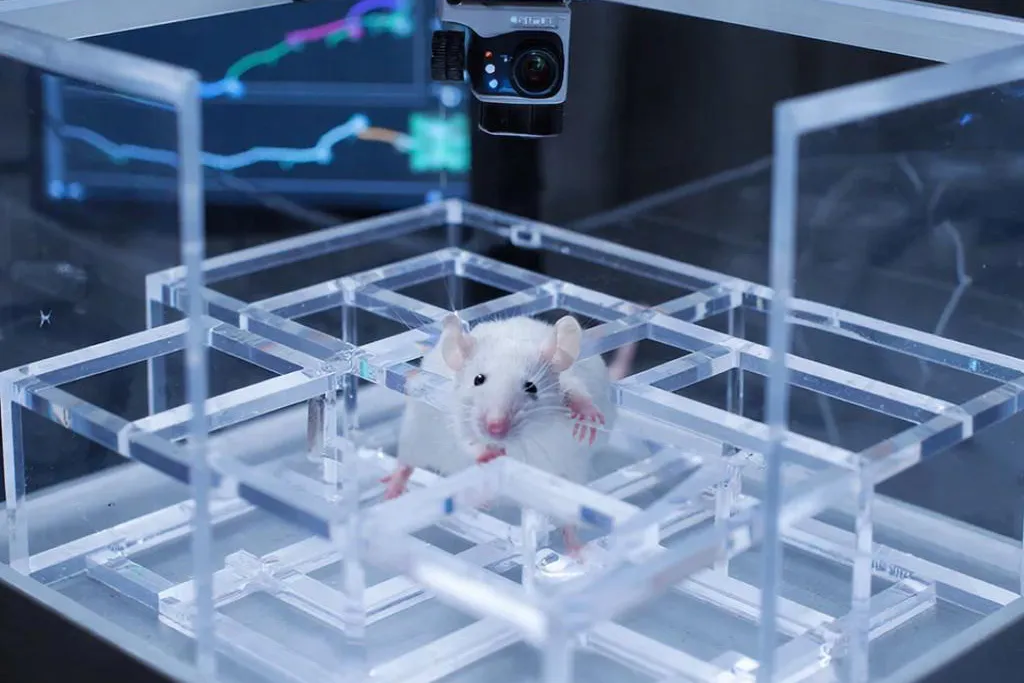
Traditionally, behavioral experiments use flat arenas where animals move only horizontally. In nature, however, navigation occurs in full 3D—requiring climbing, descending, and traversing multi‑level structures. To better replicate these natural conditions, scientists from the MSU Institute for Advanced Brain Studies and the Faculty of Biology built a sophisticated 3D maze and created algorithms capable of analyzing movement within it.
The core innovation lies in combining inexpensive hardware with a powerful mathematical framework. Using only a standard video camera and the DeepLabCut machine‑vision system, the team successfully reconstructed the mice’s three‑dimensional trajectories. A specialized algorithm compensates for image distortions and converts a flat video frame into a volumetric representation.
Integrated Into Sphynx
Even when an animal briefly disappeared from view or when glare occurred, the software reconstructed its path using knowledge of the maze’s structure. The module automatically classifies segments of the route, calculates elevation gains and drops, detects transitions between levels, and identifies zones where the animals slow down or accelerate.
The tool is already integrated into the Sphynx software platform. All code and documentation are openly available on GitHub, allowing researchers worldwide to apply and adapt the system for their own experiments.
This development is a vivid example of successful digital experimentation in fundamental science. It deepens our understanding of memory and navigation mechanisms—key domains in cognitive research. Techniques refined on animal models may eventually contribute to new diagnostic tools in medicine and more advanced artificial‑intelligence systems.