Smart Leak Protection Meets the Connected Home: NEPTUN and Dom s Alisoy Bring Water Control Into One Ecosystem
Yandex and Russian leak protection manufacturer NEPTUN have launched a joint solution that integrates automatic water shutoff into the Dom s Alisoy (Home with Alice) smart home platform. The release marks another step in the evolution from standalone sensors to fully integrated, voice-controlled home automation systems.

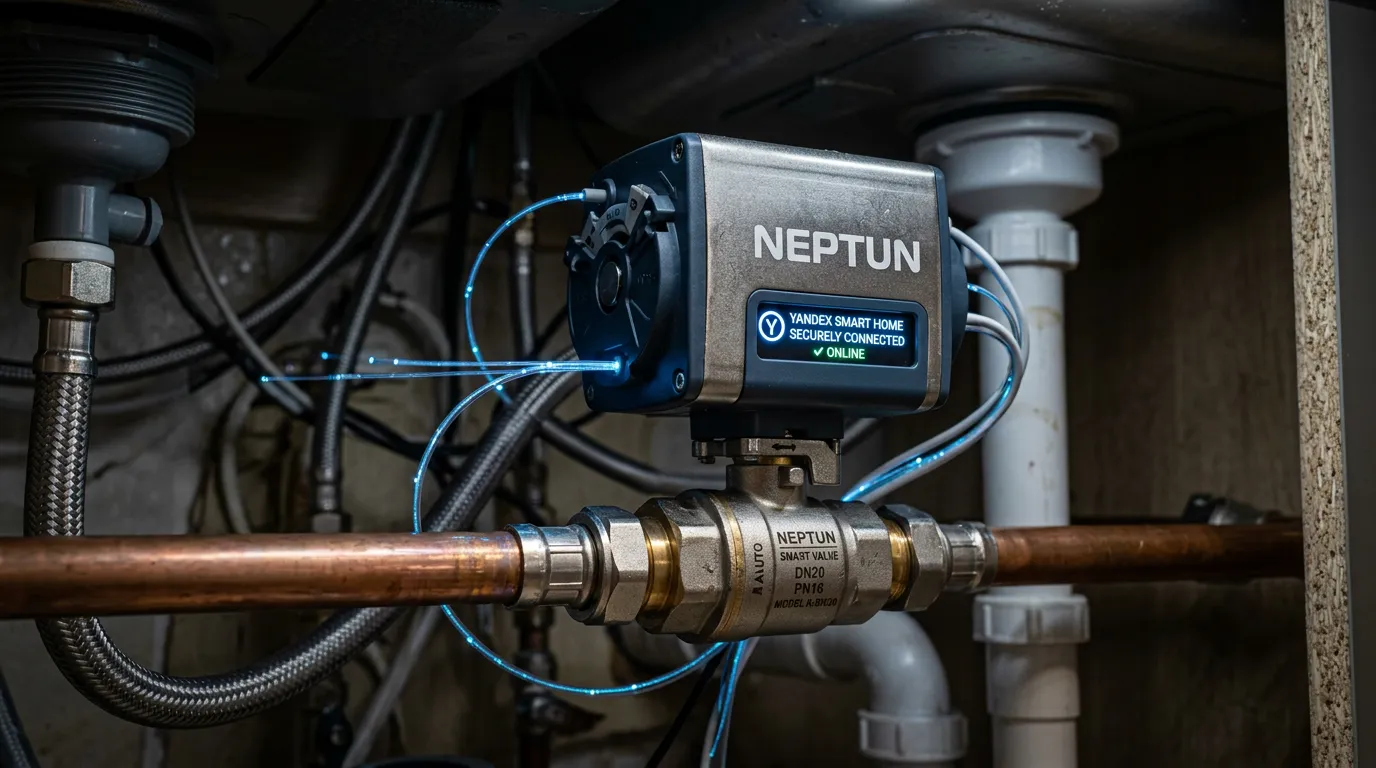
Automatic leak protection systems are already widely available, but the joint solution developed by Yandex and NEPTUN adds several new capabilities. As before, once detectors identify a leak, the system automatically shuts off the water supply. Now, however, when the control module receives that signal, it also alerts the homeowner about the incident. Notifications can be delivered through a smartphone push notification, an SMS message, or a voice announcement via a Yandex Station smart speaker.
In addition, the Dom s Alisoy (Home with Alice) app allows homeowners to create their own automation scenarios. For example, they can turn off the lights, electricity and water whenever they leave home, or issue a separate command to shut off only the water supply. Users can also ask Alice to ignore routine wet floor cleaning to prevent unnecessary sensor activation. Because the system uses the Zigbee protocol, its core functions continue to operate even when the Internet connection is unavailable.
The leak protection system also includes a built-in backup battery, allowing it to continue operating for up to 30 hours during power outages. The system can be installed in both apartments and single-family homes. It is available in three configurations, including versions equipped with smart water meters.
Growth Opportunity: Outlook for the Russian Market
Leak protection systems integrated with smart home platforms have strong potential in Russia's mass residential construction sector. In business-class apartment developments, developers can incorporate such systems during the design phase or install them at the homeowner's request while construction is still underway. Adoption is also expanding steadily in suburban and rural homes.
More broadly, Russia's smart home market continues to grow. According to research by the Doma.ai platform, six out of ten residents of apartment buildings already use at least one smart home device.
Looking ahead, these systems could also connect to the digital platforms used by property management companies. In practice, information about a leak could be transmitted directly to utility service providers, allowing them to respond more quickly and reduce property damage.

From Standalone Sensors to Smart Home Systems
Yandex has been steadily expanding this product category in recent years. In April 2023, the company introduced five smart sensors supporting the Zigbee protocol. They detected open windows and doors, monitored motion, and tracked changes in lighting, temperature and humidity. The leak sensor could notify users about a problem but was not integrated with an automatic water shutoff system.
In March 2026, Yandex updated its sensor lineup based on user feedback. Both the external design and several engineering features were revised. In June, the company added a presence sensor that goes beyond motion detection by identifying whether someone is actually in a room and estimating that person's location.
The partnership with NEPTUN became the next logical step. The system now not only shuts off the water supply automatically but also informs the homeowner whenever a leak occurs.

A Unified Control Environment
The joint development by Yandex and NEPTUN is more than another smart home device. It reflects the Russian market's gradual shift from individual sensors toward integrated engineering systems capable of preventing accidents on their own.
In the near future, the company could establish partnerships with residential developers, allowing the cost of the equipment and installation to be included in the purchase price of a home. Against the overall cost of a property, the additional expense would be relatively modest, while buyers would receive a fully operational smart home system instead of installing one after moving in.
Over time, such systems could also support automatic resource consumption analysis, preventive maintenance, and digital interaction with property management companies.