AI Is No Longer a Black Box: Russian MolgraphX Method Teaches Neural Networks to Reason Like Chemists
Researchers at the Artificial Intelligence Research Center of Lomonosov Moscow State University have developed a method that explains the decisions made by graph neural networks when analyzing molecules. The findings were published in the Journal of Chemical Information and Modeling.

An artificial intelligence model predicts with 99% confidence that a newly synthesized compound could become a breakthrough drug. Yet when researchers ask why, the model remains silent. For a programmer, that may simply be a probability score. For a chemist, however, it can be a reason to reject the candidate altogether. Scientific research cannot rely on blind trust in algorithms.
The problem becomes particularly acute when analyzing symmetric molecules. Many existing methods for interpreting neural network predictions evaluate individual atoms and chemical bonds independently while overlooking molecular symmetry. As a result, chemically identical structural fragments may receive different importance scores, contradicting the way chemists understand molecular architecture.
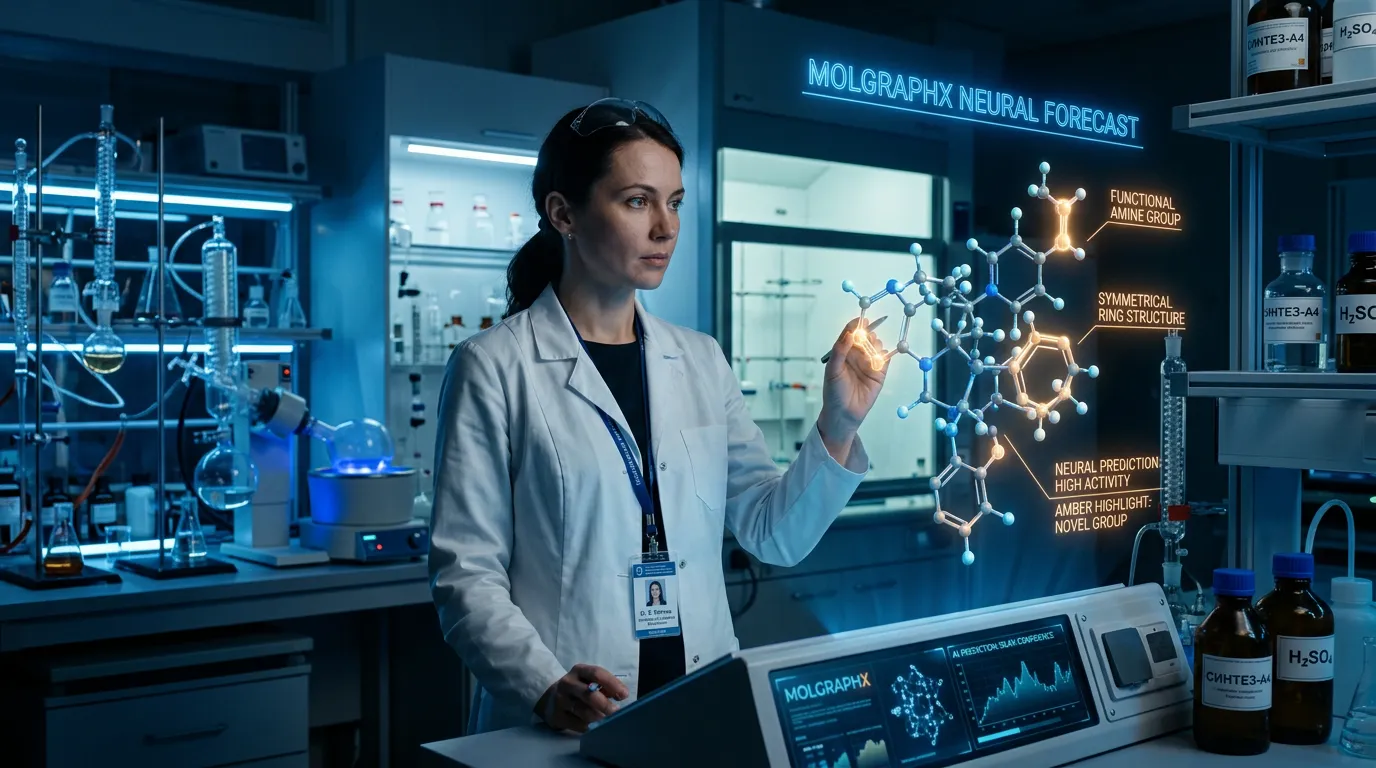
To address that challenge, the Russian research team developed MolgraphX. The method identifies how individual atoms and molecular fragments contribute to the predictions of a graph neural network while explicitly accounting for molecular symmetry. That produces explanations that better reflect established chemical reasoning and makes it possible to connect AI predictions to specific structural features of a compound.

Breaking Open the Black Box: Translating Chemistry Into the Language of Neural Networks
Graph neural networks have become one of the primary tools for discovering new materials and drug candidates. They represent molecules as graphs in which atoms serve as nodes and chemical bonds as edges. The challenge is that these models often reach their conclusions by relying on hidden patterns that remain invisible to human researchers.
MolgraphX changes that equation. Rather than producing only a prediction, the algorithm highlights the specific atoms and molecular fragments that influenced its conclusion. Just as importantly, the method developed at Moscow State University accounts for molecular symmetry – a fundamental property that many previous AI approaches largely overlooked. In blind evaluations, chemists concluded that MolgraphX explanations were fully consistent with accepted chemical reasoning. At the same time, the method maintained high computational efficiency even when analyzing very large molecular structures.
Why It Matters for Russia – and Beyond
For Russia's IT sector, the work represents another step toward strengthening domestic expertise at the intersection of machine learning and cheminformatics. Over time, MolgraphX could become a core component of Russian software platforms serving pharmaceutical and petrochemical companies. The groundwork for that ecosystem already exists. The Sintelly platform successfully predicts chemical reactions and generates novel compounds. Integrating explainable AI into platforms like these would allow researchers not merely to search blindly for new polymers or catalysts, but to design them with a clear understanding of the underlying chemistry.
For the public, the implications are straightforward: faster development of safer medicines and more environmentally friendly materials. For the global scientific community, the method addresses one of artificial intelligence's most persistent challenges – building trust in machine-generated predictions.
From "What?" to "Why?"
Viewed in retrospect, the trajectory is clear. In 2024, Russian chemists trained neural networks to identify molecular structures from microscope images. In 2025, presentations at the Russian Academy of Sciences emphasized that while AI was accelerating data analysis, progress remained constrained by the quality of available datasets. In the spring of 2026, Moscow State University introduced the gSelformer-MV architecture for analyzing textual representations of molecules. Later that summer, a joint team from the Russian Academy of Sciences, Moscow State University, Skoltech and the Higher School of Economics improved methods for calculating molecular properties. MolgraphX represents the logical next step in that progression. The field has moved beyond asking, "What does the model predict?" The more important question has become, "Why did the model reach that conclusion?"

The Biggest Constraint – and Export Opportunities
The remaining obstacle is that even the most capable AI system cannot learn without high-quality data. Standardized experimental datasets suitable for training molecular models remain in critically short supply. MolgraphX cannot eliminate the need for laboratory experiments.
Even so, the method has significant export potential. Distributed as software libraries or modular components, it could be integrated into global cheminformatics platforms. Its principal advantage is that it presents AI reasoning in terms that chemists already understand.
Artificial intelligence in chemistry is no longer a mysterious oracle. It is becoming a powerful but transparent research tool – one that takes over computational routine while leaving the most important tasks to scientists: interpretation, understanding and creativity.