Drug Traffic Light: Russia Develops AI Module to Assess Risks from Multiple Medications
Researchers in Russia have developed a system that warns physicians about dangerous drug combinations. According to World Health Organization statistics, the risk of adverse effects can reach 100% when multiple medications are taken simultaneously. Here's how the new technology could help physicians and patients avoid hazardous drug interactions.
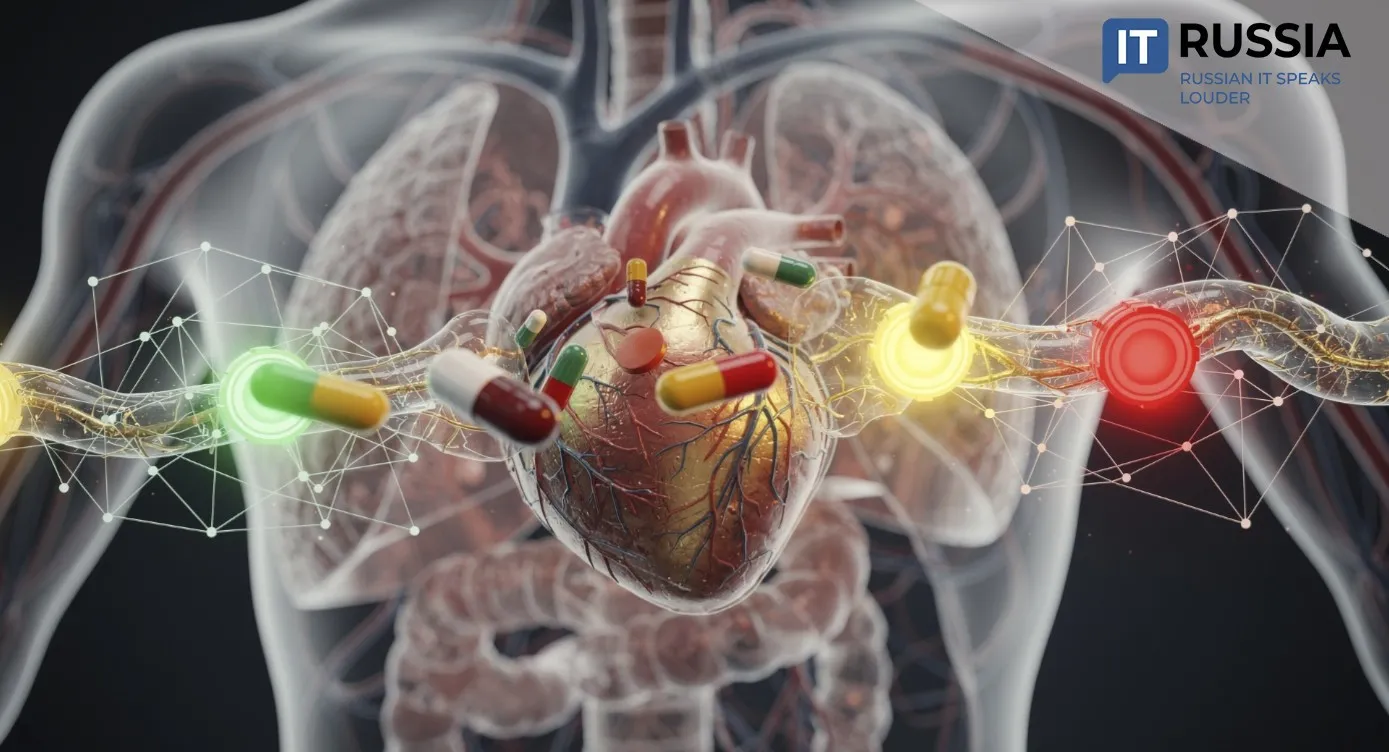
Students at the Moskovsky Aviatsionny Institut (MAI) (Moscow Aviation Institute), with support from the Plekhanov Russian University of Economics and the Russian Science Foundation, are developing a system that could fundamentally change how medications are prescribed. The project centers on an AI module that evaluates the risks associated with taking three or more medications at the same time. It operates on a traffic-light principle: green indicates compatibility, yellow signals potential risks, and red warns of a dangerous combination requiring changes to the treatment plan.
The development could be particularly useful for patients with cancer and those living with multiple chronic conditions. For these patients, determining whether medications are compatible can literally become a matter of life and death.
How the "Traffic Light" Works
The module is built around a Bayesian network, a probabilistic model that accounts for numerous factors and the relationships between them. The system analyzes official prescribing information from Russia's State Register of Medicines. It considers not only direct contraindications but also situations in which several drugs affect the same organ, creating a risk of overdose.
The physician enters the list of prescribed medications, along with the patient's age and sex, into the interface. The module checks for drug interactions, evaluates the risk of adverse reactions and identifies dangerous combinations. It then constructs a chain of cause-and-effect relationships, showing the mechanism that could trigger an unwanted physiological response while also estimating the probability of that adverse event. That significantly reduces the physician's workload, enables timely adjustments to treatment plans and helps protect patients from preventable complications.

Why It Matters
According to World Health Organization statistics, the risk of adverse reactions is about 39% when a patient takes two or three medications simultaneously. When the number increases to four or five, the risk rises to 88%. With six or seven medications, it reaches 100%. In other words, every patient taking more than three drugs enters a high-risk category. This is particularly true for people with chronic diseases who remain on long-term treatment while continually adding new medications to their regimens. The consequences extend far beyond mild allergic reactions such as hives. One of the most dangerous outcomes is angioedema, an acute and potentially life-threatening condition.
"A platform is currently being developed at the Plekhanov Russian University of Economics to reduce the number of adverse drug reactions. It analyzes complex combinations of prescribed medications and warns physicians about potential health risks. The verification software module we are creating is an important component that makes both the analysis and its results as clear and understandable as possible for physicians," the project team said.

What Has Been Accomplished So Far?
During the first phase, the database was populated with information on 92 commonly prescribed medications used to treat chronic heart failure and influenza, while researchers also identified 110 serious adverse effects.
Testing of the module is continuing. Looking ahead, the developers plan to integrate the solution into clinical information systems such as EMIAS (Unified Medical Information and Analytical System). The project is funded through a grant from the Russian Science Foundation. Several research institutes and practicing physicians have also joined the development effort.

A Socially Significant Innovation
The work of these young researchers addresses a real problem that has become increasingly urgent not only in Russia but worldwide. Polypharmacy – the simultaneous use of multiple medications – has become increasingly common, particularly among older adults. The AI module could become a practical tool that makes treatment both safer and easier to manage for physicians and patients alike.
The project is still in the testing phase, so it is too early to describe it as a commercial product. The underlying concept, however, is broadly applicable. The system could be adapted for fields beyond healthcare wherever risk assessment depends on complex, multilayered cause-and-effect relationships. One example identified by the developers is aviation, where intermediate nodes could represent physical processes such as heating or vibration, while end points would correspond to potential equipment failures.
For Russia, the project also demonstrates how students and early-career researchers are applying modern technologies and artificial intelligence to solve complex medical challenges.