Neural Network Developed in Russia to Recreate the Appearance of Destroyed Churches
The algorithm analyzes photographs of surviving fragments and reconstructs the original appearance of architectural monuments.
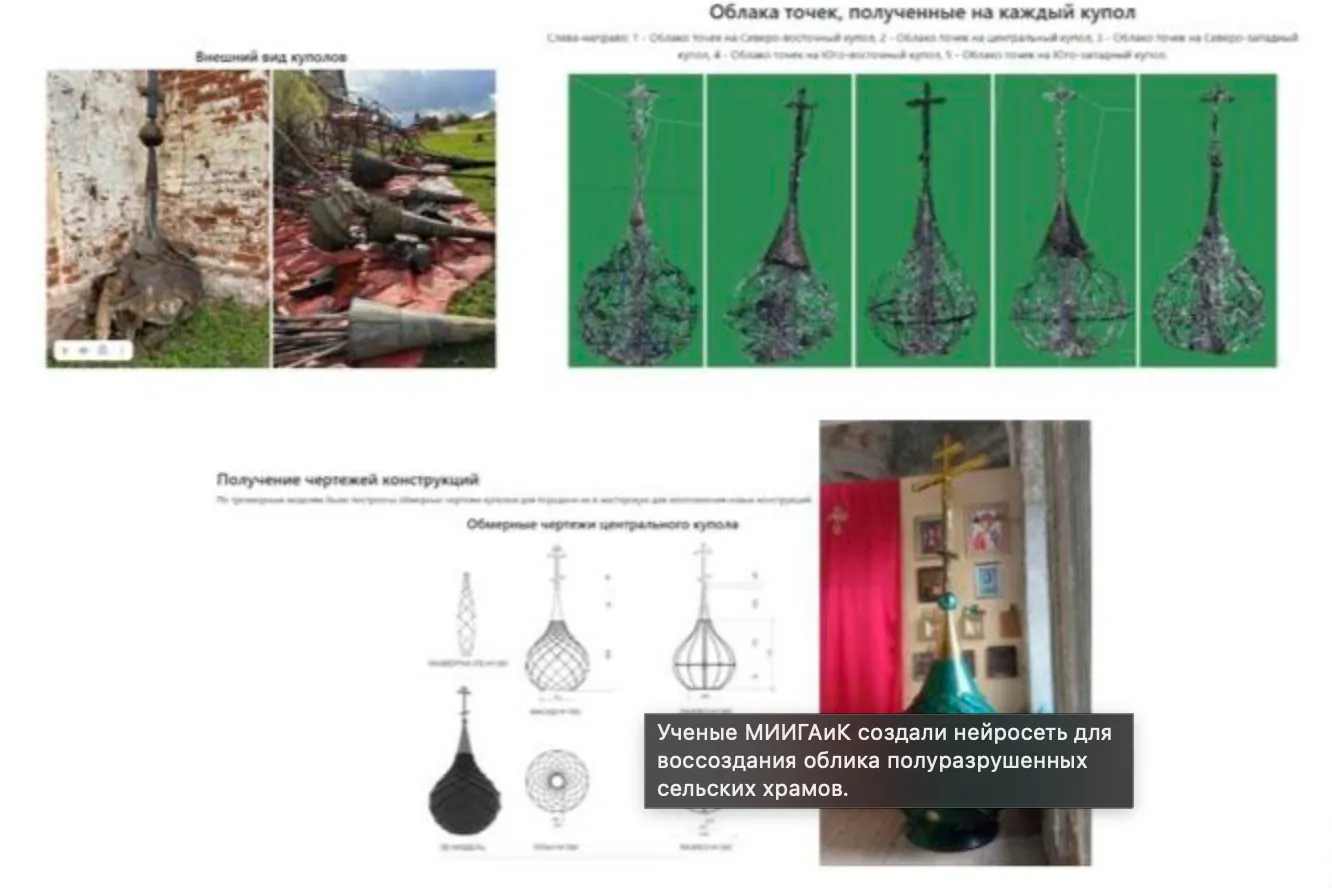
Researchers at the Moscow State University of Geodesy and Cartography have developed algorithms and models for 3D reconstruction of cultural heritage sites. The technology is based on a hybrid approach combining photogrammetric methods with artificial intelligence.
The algorithm “looks” at photographs of preserved fragments and digitally “completes” them, restoring the original appearance of an architectural monument. The university’s press service told IT Russia.
Churches Come Back to Life
Many abandoned and deteriorating churches in villages are not included in Russia’s official lists of architectural heritage. This has not diminished interest from historians, architects, and restoration specialists. Most of these buildings are more than a century old and still preserve fragments of original wall paintings and frescoes. The condition of some structures is severe — domes have been destroyed or completely lost, floors and ceilings have collapsed. Studying such sites directly is often impossible.
This is where the neural network comes in. The algorithm reconstructs partially destroyed buildings and produces a realistic 3D model of a church.
One of the project’s outcomes is the creation of neural network models for 3D reconstruction. A database has also been developed containing more than 200 three-dimensional models of Orthodox churches along with annotations.
Artificial Intelligence, Like a Child
The project was led by Tatyana Skrypitsyna, acting head of the university’s Department of Photogrammetry, a PhD in engineering and associate professor. The work was supported by a grant from the Russian Science Foundation.
Going forward, the researchers plan to further refine the trainable models.
As the Artist Created It
Existing Russian analogues can “reveal” discovered frescoes, enhance images, or extract elements of painting or text from spectral channels. However, they cannot reconstruct lost fragments. This is what makes the university’s project unique. It is able to visualize and present the original masterpiece as it was created by the artist.
The software module offers scientifically grounded reconstruction options. Its interface is intuitive, and the system can be used by non-specialists. The program can be easily adapted to specific tasks and runs on a standard personal computer, making it accessible to restoration workshops across the country.
The software has already helped restore the lost domes of the Church of the Resurrection in the village of Ostrov. The first dome has already been delivered to the site, while the remaining ones are currently being manufactured and will be installed on the bell tower.