Russian Scientists Train AI to Find Stable Rare-Earth Complexes
Researchers at the Interdepartmental Laboratory of Intelligent Chemical Design at the Faculty of Chemistry of Lomonosov Moscow State University, working with colleagues from the university’s Faculty of Mechanics and Mathematics, have developed a new machine-learning model for assessing the stability of rare-earth element and trivalent actinide complexes. The work was published in the highly ranked Journal of Chemical Physics.
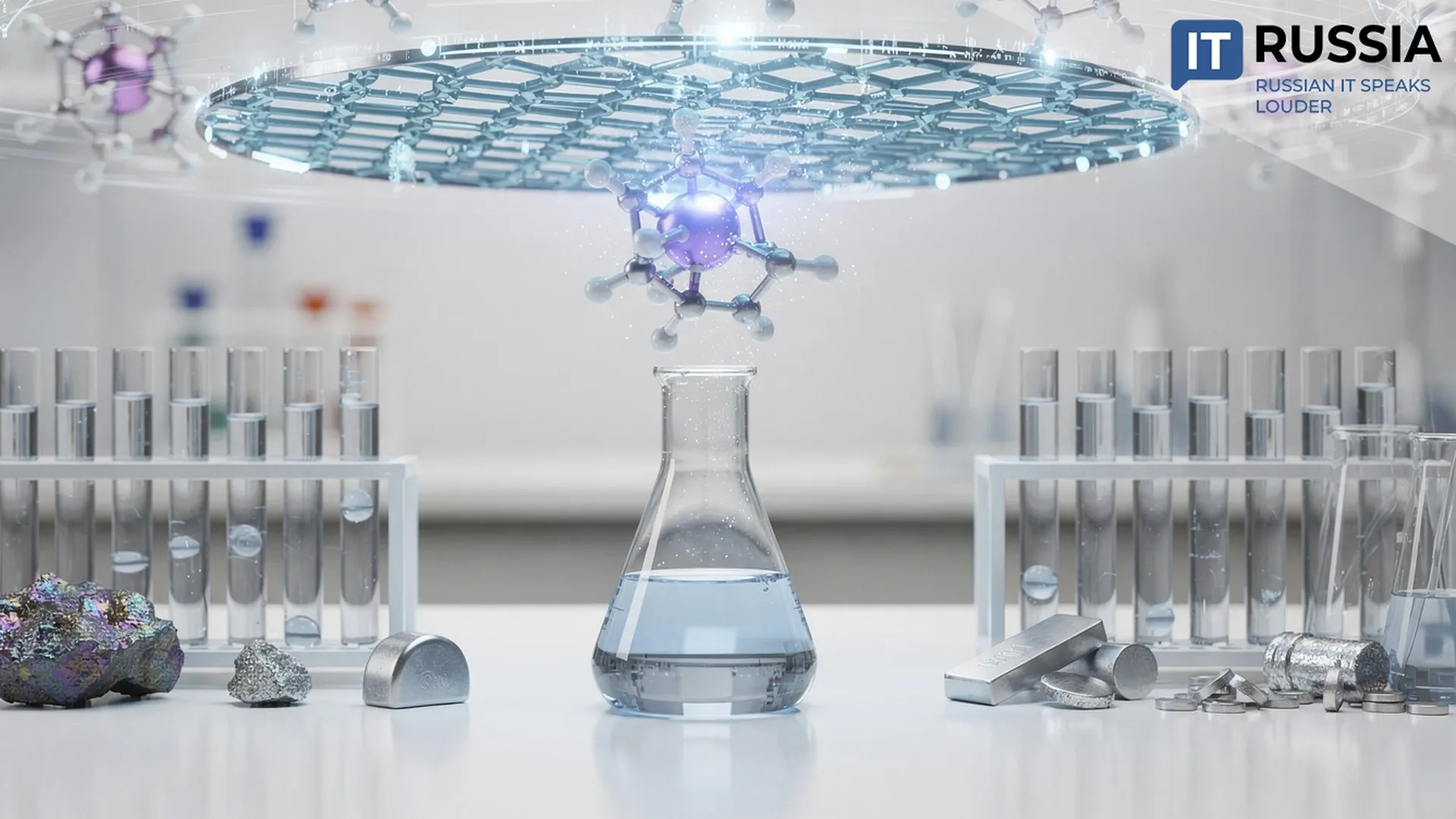
Chemistry long remained a science in which success depended on a researcher’s intuition and thousands of hours of painstaking laboratory experiments. But a new reality is emerging at the intersection of disciplines. Chemists and mathematicians at Moscow State University have created a machine-learning model capable of predicting the behavior of highly complex chemical compounds. These are complexes of rare-earth elements and trivalent actinides – notoriously challenging substances that require enormous resources to study.
Graphs Instead of Test Tubes
At the core of the approach is a graph convolutional neural network. The algorithm represents molecules as graphs, with atoms as nodes and bonds as edges. By training the model on a new database compiled from scientific reference sources, the researchers taught the AI to predict a complex’s stability constant. F-elements and actinides have complicated electronic structures, while experimental data on them have historically been scarce.
The key value lies in the computational approach: rather than simply using an off-the-shelf AI service, the researchers built a specialized architecture that uses high-performance computing. Moreover, the algorithm can assess complexes containing metals that were entirely absent from the training set. The source code is open, and the tool effectively becomes a digital sieve, filtering out candidates likely to fail before expensive experiments even begin.

A Strategic Shield: From Gadgets to Nuclear Energy
At first glance, this may look like purely fundamental science. But the research also has practical implications. Rare-earth metals are the lifeblood of modern electronics, permanent magnets, lasers and batteries. Actinides, meanwhile, are directly relevant to radiochemistry and the safe reprocessing of spent nuclear fuel.
For Russia, the development fits into its technological sovereignty strategy. The Novye materialy i khimiya (New Materials and Chemistry) national project has set an ambitious goal: to critically reduce dependence on imports of rare metals by 2030. MSU’s AI model can accelerate the search for selective compounds used to separate rare-earth metals, lowering the cost of developing domestic high-tech production. Beyond reducing import dependence, the field also has export potential: in the medium term, this could include Russian scientific software and computational materials science platforms.

The Global Context and the Emergence of a Russian School
Science worldwide is moving in the same direction. In 2023, Google DeepMind’s GNoME predicted 2.2 million new crystal structures, demonstrating that AI is becoming a major tool for initial screening. But while Western approaches are often geared toward large-scale datasets, the Russian research targets specific niches where data are scarce.
MSU has been steadily building its own school of research at the intersection of radiochemistry and data science. As early as 2022, researchers there applied transfer learning to work with small datasets. In 2024, together with Bauman Moscow State Technical University, they created an accessible AI service for materials scientists without programming skills. In 2025, the focus shifted to predicting the properties of 5f elements from X-ray data. Together, these efforts are building a distinctive set of new capabilities.
The Technological Sovereignty Pipeline
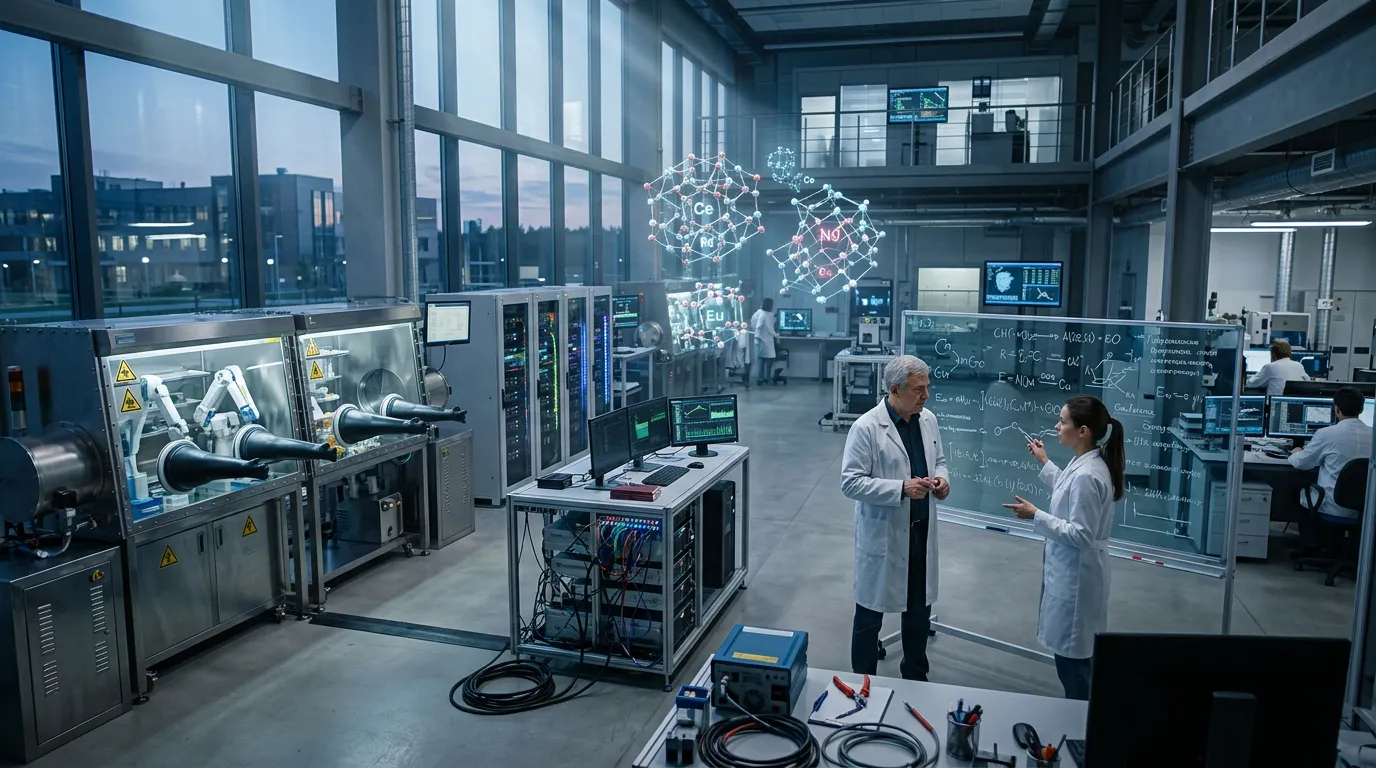
The researchers plan to experimentally validate the AI’s predictions and expand the range of compound classes it can handle. But the broader goal is far more ambitious. The value of the development lies not simply in having a neural network, but in integrating it into a unified digital platform. The ideal pipeline looks like this: data collection → computational modeling → AI screening → targeted laboratory experiment → industrial technology.
If Russia can build this closed-loop process around its own scientific software, the result will be more than a collection of individual algorithms – it will provide a comprehensive foundation for breakthroughs in materials science and radiochemistry.