Future Starts This September: Ministry to Develop AI Courses for Universities
The Ministry of Science and Higher Education, working with academic and industry experts, is preparing mandatory foundational AI modules for national higher education standards, along with discipline-specific courses tailored to students' future professions.

A graduate in economics could use a neural network to forecast market trends. A young engineer might rely on artificial intelligence to calculate the parameters of a future bridge. A medical resident could compare a diagnosis against patterns identified by an AI system trained on thousands of medical records. That is the future Russia's higher education system is preparing for.
Today, most university degree programs already include some instruction in artificial intelligence. But policymakers say that is no longer enough. The Ministry of Science and Higher Education plans to establish a dedicated federal educational and methodological association responsible for developing AI curricula across Russian universities. As early as 2025, Minister of Science and Higher Education Valery Falkov argued that an AI module should become a mandatory component of every academic program because, in his words, the technology will transform countless professions "beyond recognition."

One Standard for Everyone
Creating a dedicated educational and methodological association is more than a bureaucratic exercise. It is an attempt to bring consistency to a growing number of independent initiatives. One university may offer an advanced machine learning curriculum, another may devote only a few lectures to explaining what neural networks are, while a third may provide no AI education at all. As a result, future economists and engineers within the same country can graduate with dramatically different levels of preparation in a technology that is already reshaping virtually every industry.
The Ministry's proposal addresses several challenges at once. First, it brings university curricula closer to the needs of technology companies. It also extends AI competencies beyond traditional computer science programs. Just as importantly, it establishes common expectations for educational quality. The new organization is intended to serve as an intellectual hub that does more than approve curricula – it will keep them relevant, practical and continuously updated.
A Ranking That Serves as a Compass
In 2022, the Russian government announced the launch of 83 new master's degree programs focused on artificial intelligence. That initiative created a structured pathway for training AI professionals. Also, the government introduced subsidies for continuing education programs aimed at professionals already working with AI technologies. Learning was no longer confined to traditional university classrooms.
By 2023, those efforts had expanded to undergraduate education. According to the Ministry of Science and Higher Education, 1,625 students enrolled in specialized bachelor's programs beginning that September. At the same time, the AI Alliance, working together with the ministry, introduced Russia's first university ranking focused on the quality of AI education. It effectively became a compass, showing which institutions are setting the benchmark and which still have room to improve.
Later, the Higher School of Economics, Moscow Institute of Physics and Technology, ITMO University, Yandex and Sber jointly launched the AI360 programs. These are not simply courses but advanced programs designed to educate future AI architects and researchers – the people expected to build the next generation of foundation models and algorithms. Students gain access to major technology companies' computing infrastructure while receiving enhanced scholarships. More than 120 educational programs have already been introduced across 104 universities nationwide, with roughly 15,500 AI developers expected to graduate by 2030.
In 2025, another element was added through a competitive selection of universities participating in the federal Iskusstvenny intellekt (Artificial Intelligence) project. The initiative aligns workforce development with specific national priorities. By 2026, policymakers reached what they describe as the final step: AI modules should become part of every field of study, supported by the new federal educational and methodological association.
Faster Than Textbooks Become Outdated
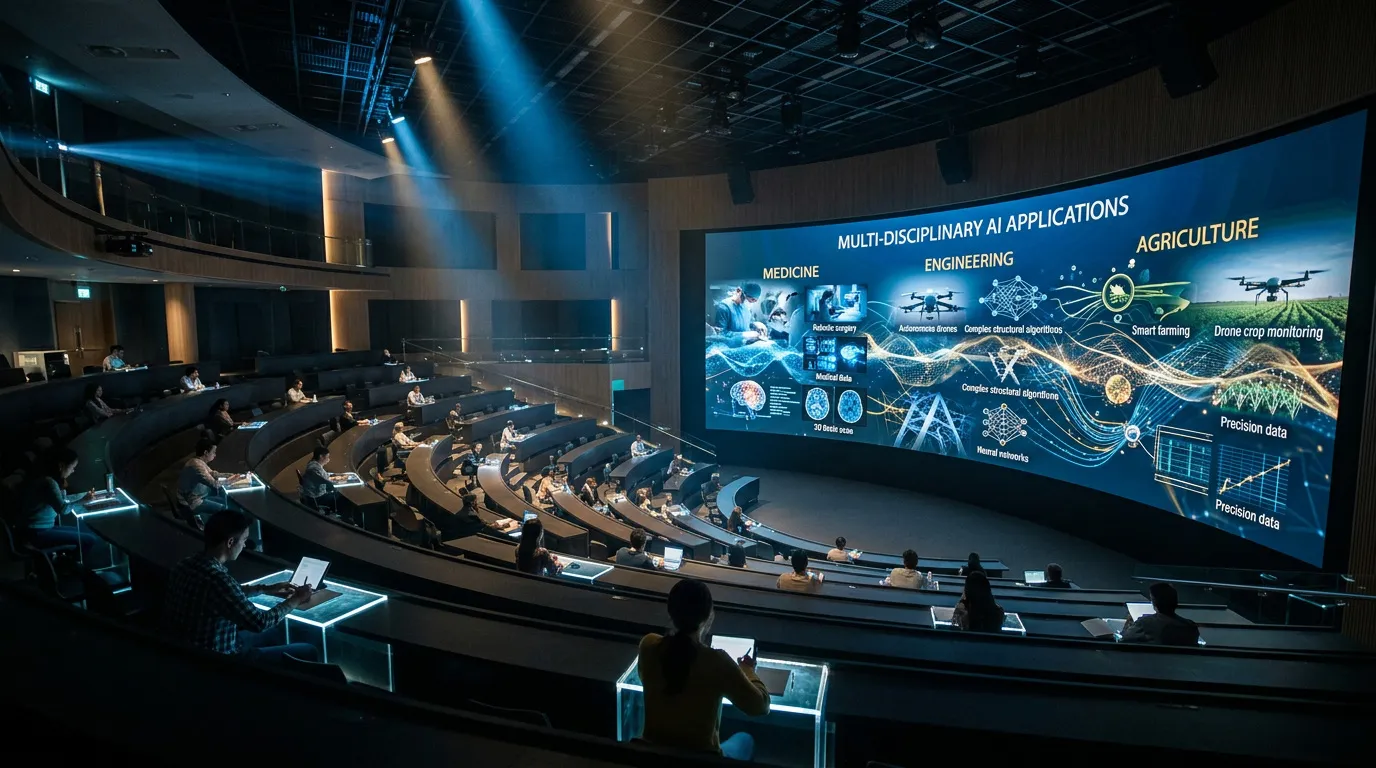
The most interesting – and perhaps the most challenging – work still lies ahead. The new organization is expected to do far more than create a standard course for universities nationwide. Its mission is much broader. Every student should leave the foundational module with an understanding of how AI works, how to work with data, how to evaluate the reliability of AI-generated results, and how to recognize the technology's ethical implications. Discipline-specific modules, however, will look very different. Engineers need to understand how AI supports computer-aided design. Physicians need to learn how diagnostic systems operate. Economists need to use neural networks for market forecasting. Educators need to know how intelligent tools can strengthen teaching and learning.
The biggest challenge will be avoiding a purely formal rollout. Faculty development will be just as important, requiring large-scale professional retraining along with broad access to software resources. Universities will also need clear policies governing the use of generative AI in coursework so students continue developing critical thinking skills. Valery Falkov has noted that AI-generated text now accounts for as much as 60% of theses in some economics programs. That trend calls not for outright bans but for new approaches to assessing student learning.
Just as importantly, academic programs must evolve faster than textbooks become outdated. AI technologies are advancing at extraordinary speed, and what is current today can become obsolete tomorrow.