

AI-powered app developed in Russia to analyse mineral composition
The new tool is designed to speed up the analysis of microscopic mineral inclusions and help predict the location of new deposits of copper, lead, lithium, gold and other metals.

Russian researchers have developed a web-based application for decoding the composition of microscopic inclusions inside minerals. The service was created by scientists from the Sobolev Institute of Geology and Mineralogy of the Siberian Branch of the Russian Academy of Sciences, the Vinogradov Institute of Geochemistry in Irkutsk, and the Fersman Mineralogical Museum in Moscow.
Minerals form the basis of rocks, and their composition carries information about the origin of mineral assemblages, as well as the depth and temperature at which they formed.
Identifying micro-minerals, however, is difficult because they are often hidden inside larger crystals. The new application is intended to simplify this process.
Algorithms at work
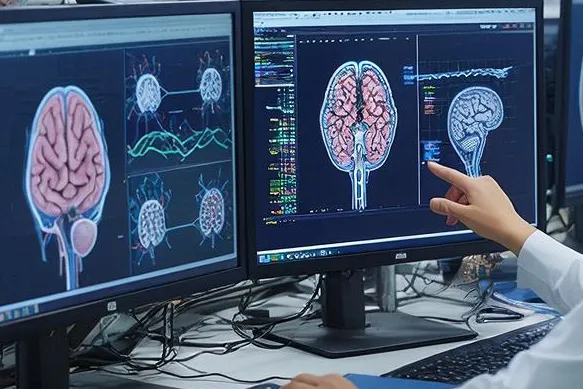
The application decodes Raman spectra, which record frequency shifts as light passes through microscopic mineral crystals. The new system reduces data processing time from several months to just a few minutes.
A phase analysis algorithm separates complex spectra into sections corresponding to individual minerals, breaking them down into simpler components. To speed up matching against reference databases, the developers integrated the Faiss indexing library, one of the most widely used tools for similarity search. It converts spectral data into numerical form and groups it according to defined parameters.
Neural networks and machine learning methods are used to recognise complex spectra, achieving mineral identification accuracy of up to 96.3%.
The researchers say the tool can also be applied to the study of substances on the surfaces of terrestrial planets, rocky moons of gas giants, as well as asteroids and comets. Analysis of micro-inclusions could help predict the location of new deposits of copper, lead, lithium, gold and other metals.