Catch Your Package: Drones Are Set to Reshape Russia’s Delivery Market Over the Next Four Years
Have you ever had an online order delivered through the air? If not, get ready. Drone delivery is no longer a distant concept. For nearly six months, residents of the settlement of Nizhny Bestyakh have been receiving parcels by unmanned aircraft.
Pizza Flies Through the Air
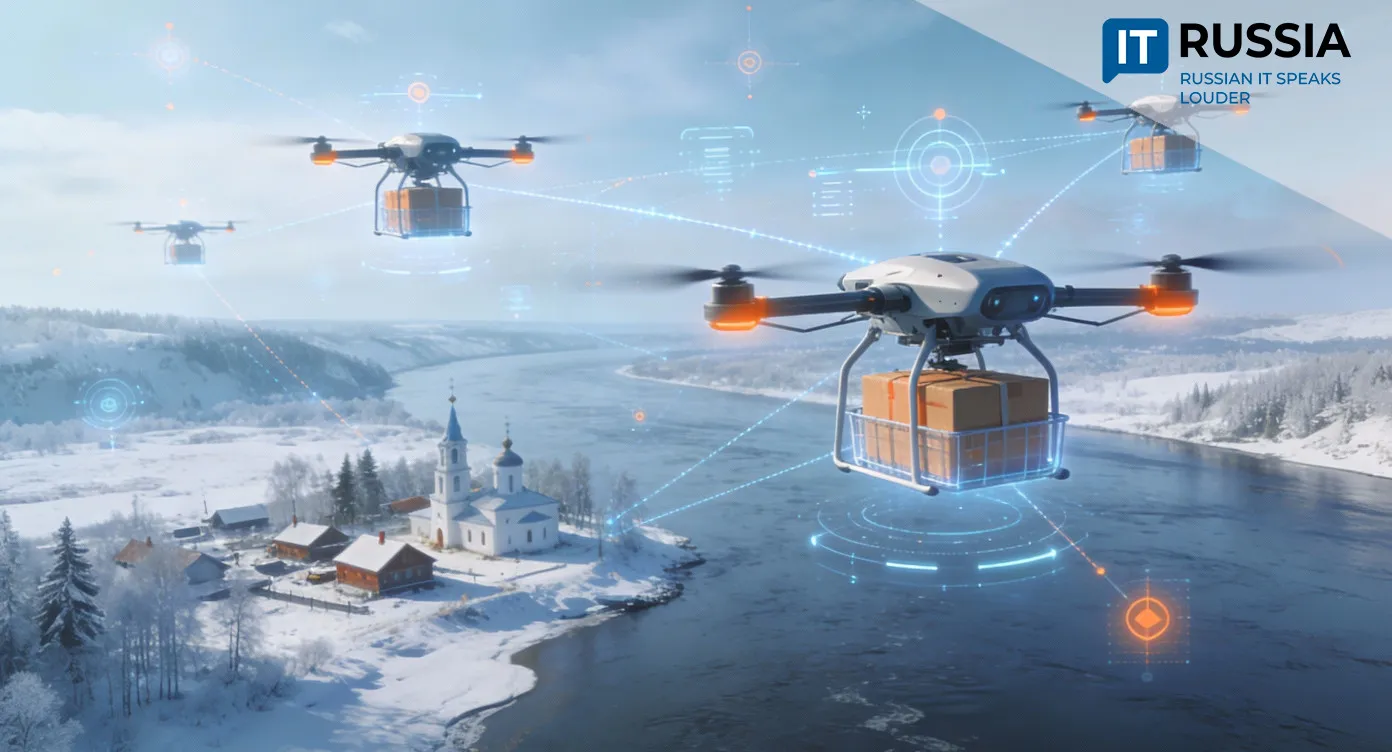
The Yakutian settlement of Nizhny Bestyakh can hardly be described as remote. It is connected by a federal highway, has a railway station, river transport in summer, and an ice crossing in winter. Yet small parcels weighing up to 10 kilograms are delivered from Yakutsk far faster by air than by land. A drone needs just 15 minutes to cross the Lena River.
Notably, residents most often ordered ready-made meals, although food was far from the only category. Drones delivered around ten parcels a day as part of a pilot project called “Air Crossing”, operated by the delivery service Boon Market.
For now, drone flights around Yakutsk are on pause. Daytime temperatures have dropped below minus 45 degrees Celsius, creating excessive strain on the equipment. And, under such conditions, ready-made food has little chance of arriving warm.
Unmanned Helpers
Russia is vast. In some regions, birds freeze mid-flight, while in others roses are still in bloom. As a result, the use of unmanned aerial systems does not come to a universal halt with the onset of winter.


Drones in Russia are used far beyond last-mile delivery. They are widely deployed in agriculture to monitor and treat crops, in construction for surveying and progress tracking, in forestry to prevent wildfires and illegal logging, and in the heat and power sector to inspect transmission lines and pipelines.
Consumer goods delivery, however, holds a special place among these applications. According to forecasts presented in 2025 at the forum “Unmanned Systems: Technologies of the Future” in Skolkovo, this segment alone could reach 25 billion rubles a year by 2030, or roughly $300 million at current exchange rates.
Government Support
Business growth in this area is being actively supported by the state. In 2024, Russia launched the national project “Unmanned Aerial Systems”, aimed at building the required infrastructure, including drone ports, supporting UAV developers and manufacturers, and training specialists for unmanned aviation. These measures are critical for technological sovereignty and for sustaining the rapid growth of the digital economy.
Scientific and industrial UAV centers are now being established across the country. Over the next four years, their number is expected to reach 48. These hubs will serve as the backbone for developing unmanned solutions for multiple sectors of the economy. Programmable flights require advanced AI, which means demand for IT solutions will continue to rise. That, in turn, creates a pressing need to adapt university and vocational education programs to a growing skills gap.
A New Economic Engine
AI-powered unmanned aerial systems represent a future that has already arrived. Both government and business are investing in this direction as a core element of the digital economy, with returns expected sooner rather than later.
The social impact is clear. Residents of a vast country gain equal access to goods and services regardless of how far they live from major centers, without inflated delivery costs. The economic impact is equally significant. It drives growth in the IT sector, scales up e-commerce, improves logistics efficiency, and enables faster, more flexible decision-making. In short, unmanned systems are emerging as a powerful engine of economic growth and technological sovereignty.