Russian Scientists Cut Research Timelines from Years to a Week with AI
Researchers in Russia have developed an AI-powered digital assistant capable of shortening the search cycle for new chemical reactions by a factor of 180 – from three and a half years to just one week. The system generated hypotheses that led chemists to previously unknown reactions, potentially useful for developing new cancer therapies.
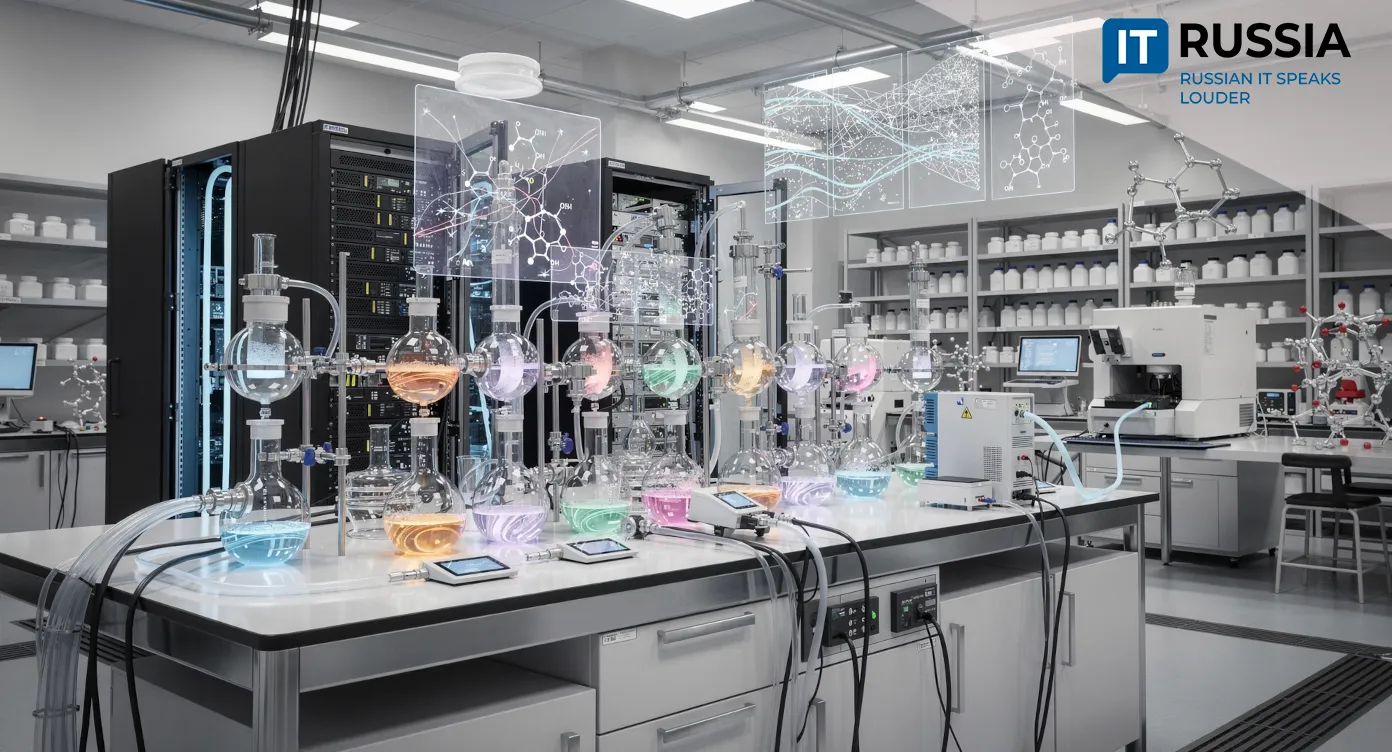
From Data to Discovery: How the System Works
Three and a half years of intensive laboratory work – or one week of AI computation? Scientists at the Zelinsky Institute of Organic Chemistry of the Russian Academy of Sciences, led by Academician Valentin Ananikov, have delivered a clear answer. With support from the Russian Science Foundation, they built an AI assistant that accelerates the discovery of new chemical reactions 180-fold. The advance elevates Russian research into the ranks of technological leaders in the narrow but strategically important field – digital chemistry.
At the core of the platform is an algorithm that analyzes molecular structures and predicts the likelihood of cycloaddition reactions. This class of reactions underpins the synthesis of numerous pharmaceutical compounds. The system processed 134,000 molecules as input and generated roughly 31,000 potential reactions. From these, researchers identified 200 options with practical application, several of which have already been confirmed experimentally. Instead of relying on trial and error, chemists now receive validated hypotheses ready for laboratory verification, fundamentally reshaping the research workflow.
A Bridge to New Medicines
The implications are particularly significant in oncology. Cycloaddition reactions play a central role in the development of anticancer drugs. Reducing the search phase for promising molecular structures from several years to a matter of days could compress the path from laboratory concept to clinical use by years. For patients whose time is measured not in calendar cycles but in treatment regimens, such acceleration carries tangible humanitarian weight. Science in this context moves beyond abstraction and becomes a practical ally in the fight for survival.

Technological Sovereignty as an Outcome
The project signals a broader strategic shift in Russia’s technology development model. Rather than relying on imported AI tools, researchers are building applied scientific platforms domestically. The emerging field of AI for Science is one of the fastest-growing segments of the global technology market, and this work demonstrates competitive capacity not only in theory, but in operational execution. Here, technological sovereignty is not a slogan but a concrete result – a platform developed on a national scientific foundation with commercial potential.
Against Global Trends
Globally, science has already embraced AI tools. DeepMind’s AlphaFold transformed protein structure prediction, and drug candidates designed by Insilico Medicine have reached clinical trials. The Russian system occupies a distinct niche. While many Western initiatives focus on biology, Russian researchers are leveraging a longstanding strength in synthetic organic chemistry. Augmented by AI, this specialization creates a differentiated competitive advantage. By 2030, the global AI-driven drug discovery market could reach tens of billions of dollars – and Russia now has a credible opportunity to secure a position within it.
What Comes Next?
The next phase is clear: integrating the platform into pharmaceutical companies and research centers, developing a platform-as-a-service model and connecting the system to high-performance computing infrastructure. Export potential is reinforced by the historic reputation of Russia’s organic chemistry school. Within the next three to five years, licensing agreements with partners in BRICS countries and across Asia are plausible, alongside growth in patent activity.

This breakthrough reflects the maturity of Russia’s “AI + science” ecosystem. When artificial intelligence shifts from being an end in itself to becoming an instrument for solving urgent human challenges – from drug synthesis to strengthening technological independence – the meaning of digital transformation becomes concrete. By compressing years of exploratory chemistry into days of computation, Russian researchers are demonstrating how saved laboratory time can ultimately translate into extended human lives.