AI Improves the Accuracy of Traffic Enforcement
Russia is moving beyond simple traffic violation detection toward a new model of road monitoring, where artificial intelligence is used not only to identify offenders but also to verify the accuracy of surveillance systems themselves.

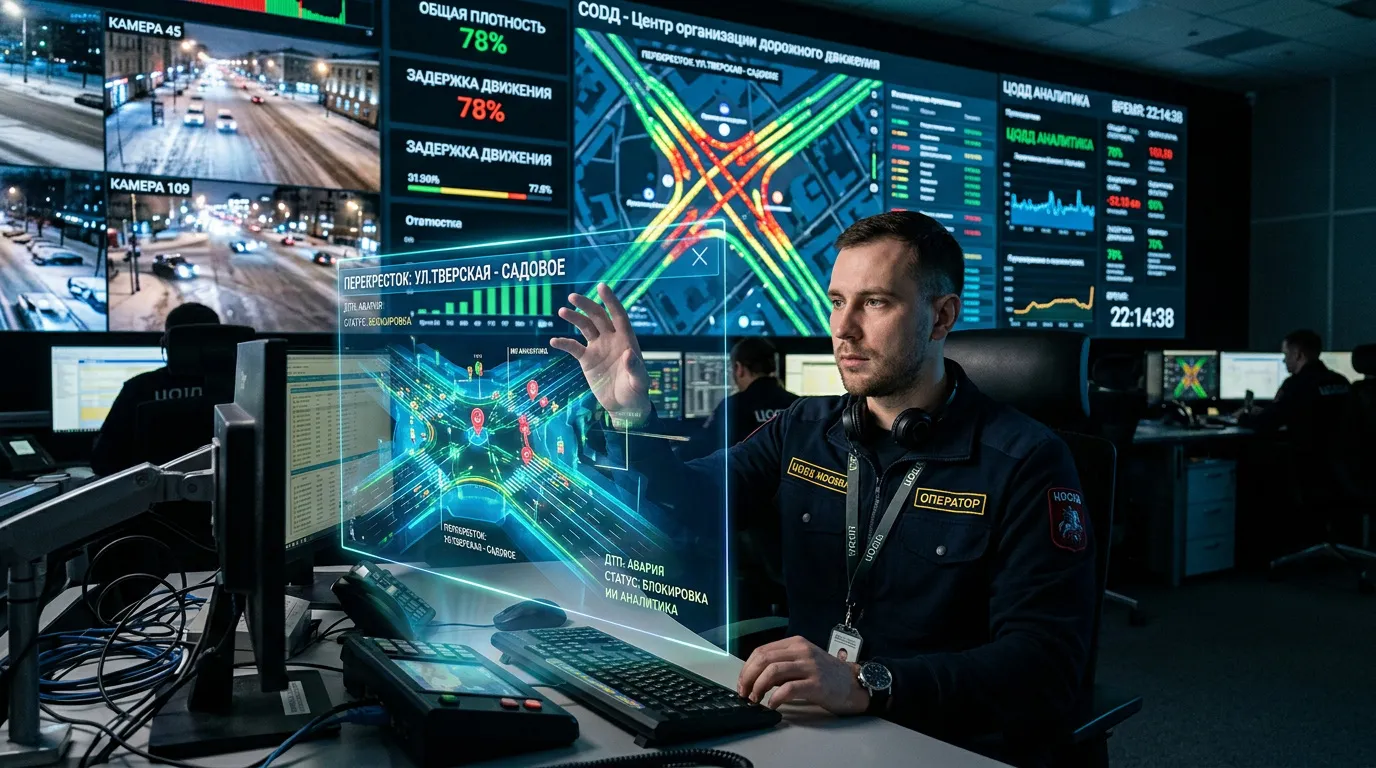
Moscow’s Traffic Management Center (TsODD) has begun using AI not only to detect violations – such as mobile phone use while driving or failure to wear a seatbelt – but also to review disputed cases. For example, AI helps prevent wrongful fines when a tow truck appears in the frame, ensuring that a penalty is not mistakenly issued to the owner of the transported vehicle.
Building Trust in Automated Enforcement
The rollout is not yet nationwide, but its impact is significant. Moscow operates thousands of photo and video enforcement systems that generate tens of millions of fines each year. Even a small reduction in error rates produces measurable benefits for both authorities and drivers.
As a result, citizens face fewer erroneous fines. Government agencies and regional authorities benefit from improved traffic management practices. At the same time, Russia’s IT sector is developing integrated solutions in trusted video analytics that must meet both technical and legal standards. Globally, this represents a shift from systems designed solely to “detect violations” toward systems capable of “verifying their own decisions.”

Toward Integrated Traffic Analytics
A key trend is the gradual integration of AI modules into existing photo and video enforcement infrastructure. Moscow’s experience shows that AI can operate effectively alongside current systems and human oversight.
System capabilities are steadily expanding. AI is now able to flag ambiguous cases, route questionable footage for manual review, and cross-check multiple vehicle attributes.
At the same time, a regulatory framework is taking shape. Requirements for camera placement and visibility are being formalized, while the Ministry of Digital Development of Russia is working on unified rules for AI use, including citizens’ rights to challenge decisions made with AI involvement.
How “Smart” Enforcement Has Evolved
The current initiative builds on a gradual expansion of AI capabilities in traffic enforcement. The shift began with the launch in Moscow in 2020, when neural network-based detection of seatbelt violations and mobile phone use while driving was introduced.
The next phase expanded both geography and deployment formats. In 2022, the Traffic Management Center began installing AI-powered cameras on patrol vehicles, moving beyond fixed infrastructure. Regulation followed technological progress: from 2024, unified rules for camera deployment prohibited the use of data from non-compliant systems for enforcement.
Each stage reflects a clear trajectory: from point detection of violations to comprehensive traffic and urban analytics, from stationary systems to mobile ones, and from technical implementation to a structured legal framework.

The Future of Smart Road Systems
Several conclusions emerge. First, Russia’s traffic enforcement infrastructure is evolving toward a more mature model, where AI not only detects violations but also reduces its own error rate. Second, the focus is shifting from the volume of fines to the quality of automated enforcement and public trust. Third, a comprehensive approach is forming that integrates technical, legal and social aspects of AI use in transportation. Finally, cross-system verification is emerging, along with broader applications of smart camera technologies beyond traditional traffic enforcement.
Over the next one to three years, a hybrid operating model is likely to expand, where AI performs both primary and secondary filtering, while human inspectors validate disputed cases. At the same time, regulatory development will continue, refining rules for AI deployment and mechanisms for appeals.
The use of AI for self-verification marks a new stage in the digitalization of transport infrastructure – a transition from “smart” systems to “verifiable smart” systems. In this model, technology serves not only as a tool of control, but also as a safeguard of fairness and legal protection for citizens.