Tomsk Engineers Develop “Thinking” Algorithm to Tackle Fires Faster
Every year, fires claim thousands of lives and destroy property worth billions of rubles, and in many cases the biggest enemy is time. Detecting ignition before it turns into a full-scale disaster is a challenge researchers around the world are racing to solve.

A Smarter Way to Spot Fire
Researchers at Tomsk Polytechnic University have developed an autonomous indoor early-fire detection system that goes beyond conventional alarms. Traditional systems rely on multiple sensors that react to smoke or temperature changes. The new approach does not just sense a fire – it interprets it. The algorithm identifies the cause, location, size and even the type of combustible material involved, while relying on a minimal set of sensors. The autonomous “brain” can be embedded into almost any infrastructure, from warehouses to apartment buildings. According to the developers, deployment is fast, cost-effective and efficient.
“Experimental data also allowed us to build 2D maps that help determine the distance to the ignition source depending on room height and the rate of change in temperature and hazardous gases,” said Roman Volkov, Associate Professor at the Research School of High-Energy Physics Processes at Tomsk Polytechnic University and one of the project’s authors.

Prevention Over Reaction
In 2024, Russia recorded 96,000 residential fires, 12% fewer than the previous year. However, child fatalities in fires increased by 20%. Behind the statistics are human lives. Each year, fires claim around 20,000 lives and destroy more than 2.5 million square meters of housing. Systems like the one developed in Tomsk offer a chance to intervene earlier.


An algorithm capable of sending an alert directly to a property owner or emergency services at the earliest stage of ignition could prevent tragedy. Such a system would also prove highly effective in industrial facilities and warehouses, where fire damage can reach millions and false alarms can halt operations.
Stopping Disaster Before It Starts
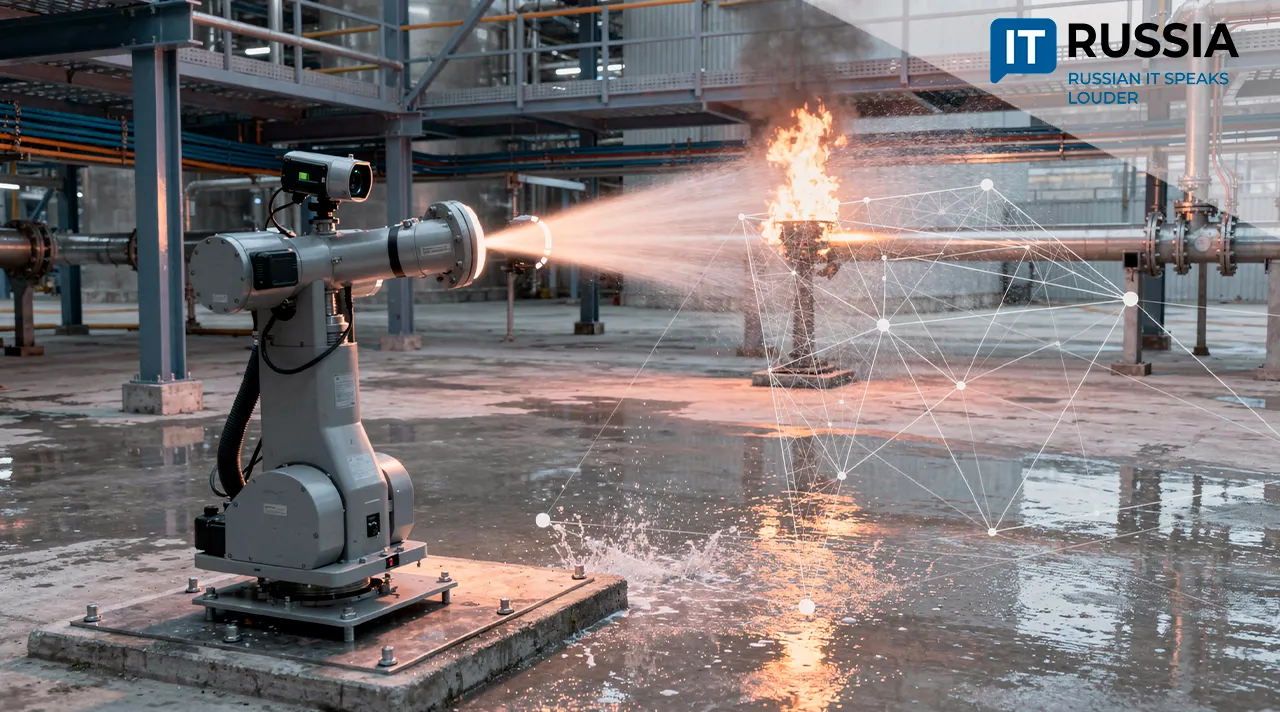
Russia has accumulated substantial IT expertise in fire monitoring, including indoor detection systems. For example, a researcher at South Ural State University developed an intelligent fire suppression system for auto service centers. It monitors conditions in real time and, if it detects hazardous substance leaks or abnormal temperature spikes, alerts staff and pinpoints the risk zone with high precision.

The Tomsk system is not just a sensor waiting for smoke to fill a room, nor a robot extinguishing an already large-scale blaze. It is an analytical platform designed to interpret conditions before they escalate. In the coming years, the system is expected to be deployed at critical and high-value facilities, where the cost of a false alarm or delayed response is too high. Later, it could be integrated into monitoring networks of the Ministry of Emergency Situations for automatic dispatch. The development team also plans to expand the algorithms to address emerging risks, including early detection of forest fires, integration with satellite monitoring data and the use of low-orbit communication networks in areas without infrastructure.