Russian Scientists Develop Smart Helmet to Control Lunar Robots
The multifocal VR helmet simulates spacewalk conditions.
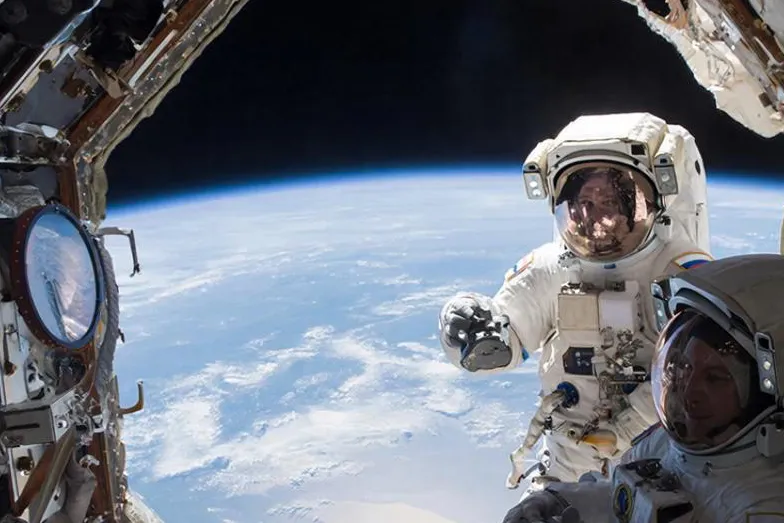
Russian scientists have developed a unique multifocal virtual reality helmet designed for astronaut training and for remotely controlling robots on the Moon. The system was created by researchers at the Institute of Automation and Electrometry of the Siberian Branch of the Russian Academy of Sciences, working in collaboration with developers from Softlab-Nsk LLC and the Design and Technology Institute of Scientific Instrument Engineering of the Siberian Branch of the Russian Academy of Sciences.
Two Mechanisms at Odds
As Mikhail Lavrentyev, dean of the Faculty of Information Technology at Novosibirsk State University, told TASS, humans rely on two primary mechanisms to judge distance in space – binocular and accommodative vision. The first is based on the fact that the two eyes see the same object from slightly different angles. The brain compares these images and uses the difference to determine depth and distance. The second mechanism involves the eye’s lens becoming more convex when focusing on nearby objects, with the brain translating this change into distance information.
False Skills Are Not an Option
During a spacewalk, a cosmonaut can spend several hours outside the spacecraft. In such conditions, every sequence of actions must be precisely rehearsed. Astronauts need to know how to operate in a spacesuit, handle tools, coordinate with the crew, and respond to emergency situations. All of these skills are refined on Earth using specialized training helmets.
The Russian-developed system significantly reduces these perceptual errors. As a result, the technology has strong potential for wider use and is likely to attract interest from the global space and research community.